
Google’s “Dive deeper” cards appeared in some AI Mode answers in November 2026, giving source links thumbnails and more screen space, according to trade reporting. That does not establish a traffic gain. Separate studies report fewer outside clicks when AI answers appear, but none evaluates the new cards. Publishers need to track link placement, cited pages and attributable visits separately, while keeping AI Mode distinct from AI Overviews.
Google gives some AI links a bigger footprint
Google’s AI Mode displayed larger thumbnail link cards in some answers on November 23, 2026, according to Search Engine Roundtable reporting collected by RankMeTech. The “Dive deeper” block places related links at the answer’s end, with images and short descriptions. It does not turn every citation into a card.
For publishers, the unanswered question is whether that extra screen space delivers visitors. The November reports describe changes in appearance, while separate click studies examine different layouts and populations. Putting them together reveals what a citation dashboard alone cannot show: whether readers leave Google.
The timing needs care. SEO Weekly’s AI Mode tracker dates an earlier thumbnail-block sighting to November 21, 2026. Neither observation establishes when, or whether, the layout reached every user.
Read the accompanying timeline as a sequence of reported observations, not a cause-and-effect chart:
- November 21, 2026: SEO Weekly reports thumbnail cards in AI Mode.
- November 23, 2026: RankMeTech dates the end-of-answer “Dive deeper” cards to this day.
- November 26, 2026: GEO Agencies reports later placement of the first inline link in AI Overviews.
The last observation concerns a different Google experience. It does not show that the cards pushed links downward. Nor does a larger clickable area establish that readers reached it, clicked it or arrived on a publisher’s site.
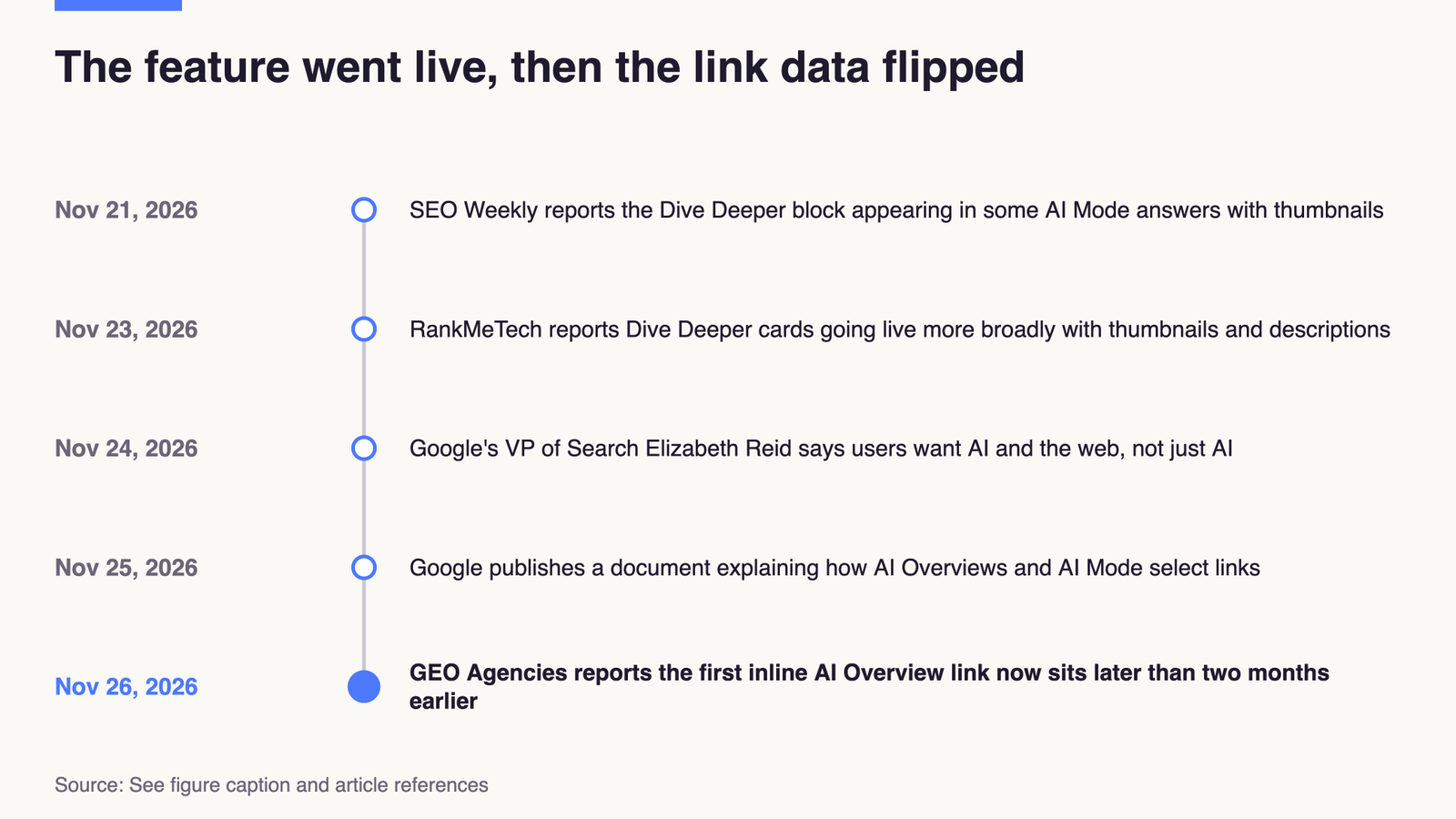
Five dated events between November 21 and 26, 2026 show new link cards arriving just before a report said the first link moved later. Method: Dates and events compiled from trade-press reporting on Google's Dive Deeper rollout, its link-selection documentation, and the follow-up link-position analysis.
The click evidence is less encouraging
The available click research gives publishers reason to look beyond appearances. A two-week randomized experiment involving 1,065 US adults found roughly 40% fewer clicks to outside websites on queries where AI Overviews appeared, according to GBP Audit Lab’s summary of Tech Policy Press coverage. The reported zero-click share rose from 54% to 73%.
That is a 19-percentage-point increase, calculated as 73 minus 54. It describes how often sessions ended without an outside click. The roughly 40% reduction measures something else: the number of outside clicks. Neither figure measures performance of the November cards.
A French analysis also reported a decline. GEO Agencies’ account of Ahrefs research describes a 24.4% click-through-rate loss across 31,612 keywords for queries triggering AI Overviews, three months after the reported July 2026 launch.
Click-through rate, or CTR, measures clicks relative to opportunities to click. A 24.4% relative loss is not a 24.4-percentage-point decline. It also does not establish an equal percentage loss in total visitors.
Keep three measures distinct when reading a performance report:
- Outside clicks: the number of clicks from Google to other websites.
- Zero-click share: the share of sessions producing no outside click.
- CTR change: the change in click-through rate relative to its baseline.
The US experiment and French keyword analysis differ in design and population. Their results cannot be combined into one traffic-loss estimate, and the supplied summaries do not provide enough detail to assess their methods fully. They make click measurement worth pursuing, without answering whether the revised cards help.
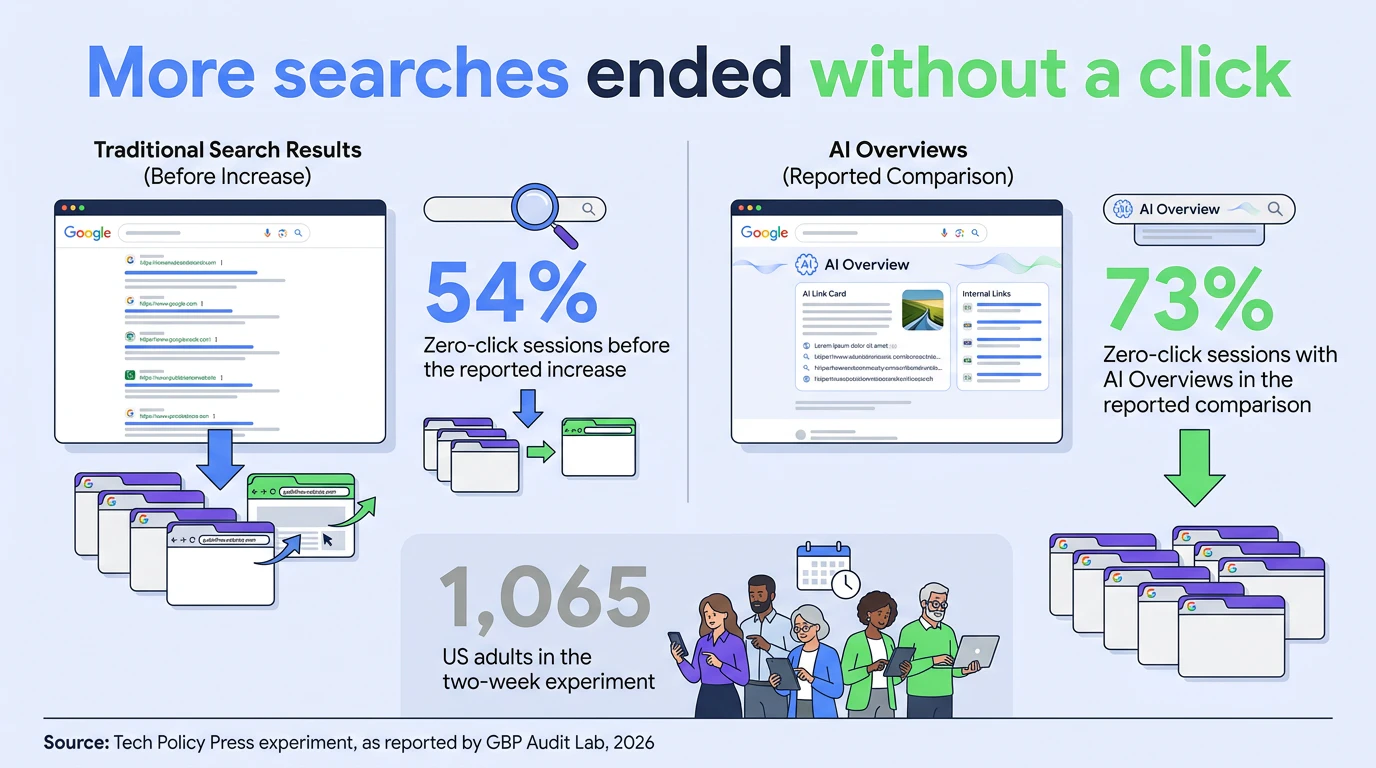
Source: Tech Policy Press experiment, as reported by GBP Audit Lab, 2026
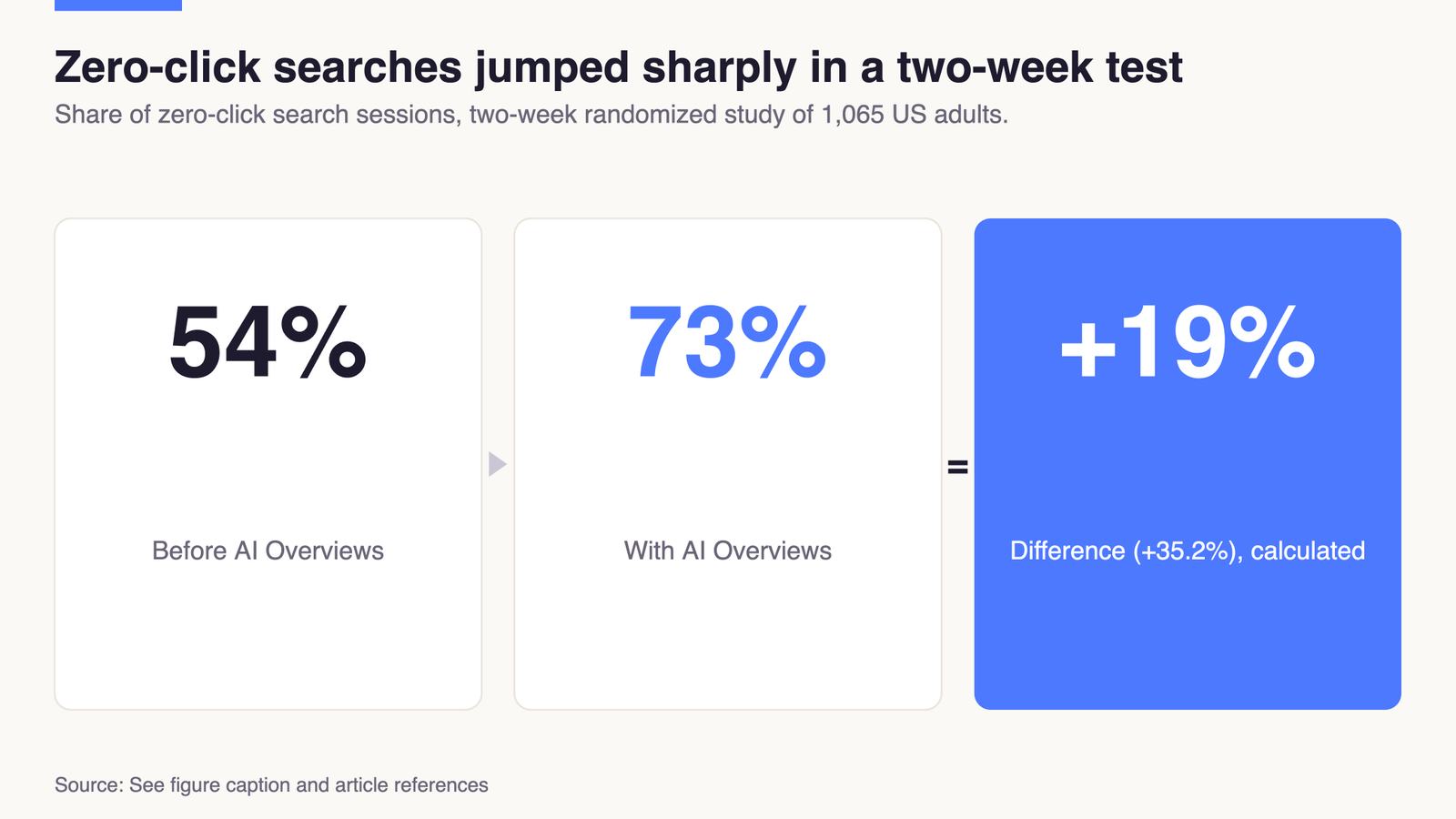
Zero-click sessions rose from 54% to 73% once AI Overviews appeared, a 19-point jump, in a randomized study of 1,065 US adults. Method: Figures taken directly from the randomized study summary; the gap is a simple subtraction, not a separately published statistic.
Two reports track different Google experiences
Two link-placement reports sound contradictory until their subjects are separated. In an observation dated November 26, 2026, GEO Agencies reported that the first inline link in AI Overviews appeared much later than two months earlier. That is a placement claim, not a measured traffic loss.
Meanwhile, AI SEO Wire reported that Google was moving AI Mode’s inline links higher in answers. One account concerns AI Overviews; the other concerns AI Mode. Both could be accurate without documenting a reversal in either product.
A useful comparison would need details absent from the supplied evidence:
- Matched queries: Were the same searches tested?
- Dates and devices: Were observation conditions comparable?
- Answer lengths: Did links move, or did responses grow longer?
- Placement definitions: Did “higher” mean screen position, scroll depth or fewer words before a link?
Counting creates another problem. SEO Weekly’s November 26, 2026 account says Google’s AI answers showed two separate source panels and warns that measurement tools could miscount them. A source-panel entry is not the same placement as an inline link.
Publishers therefore need repeat observations within each experience, with link types labeled separately. The available reports cannot establish why placement changed, much less attribute it to a particular model or ranking update.
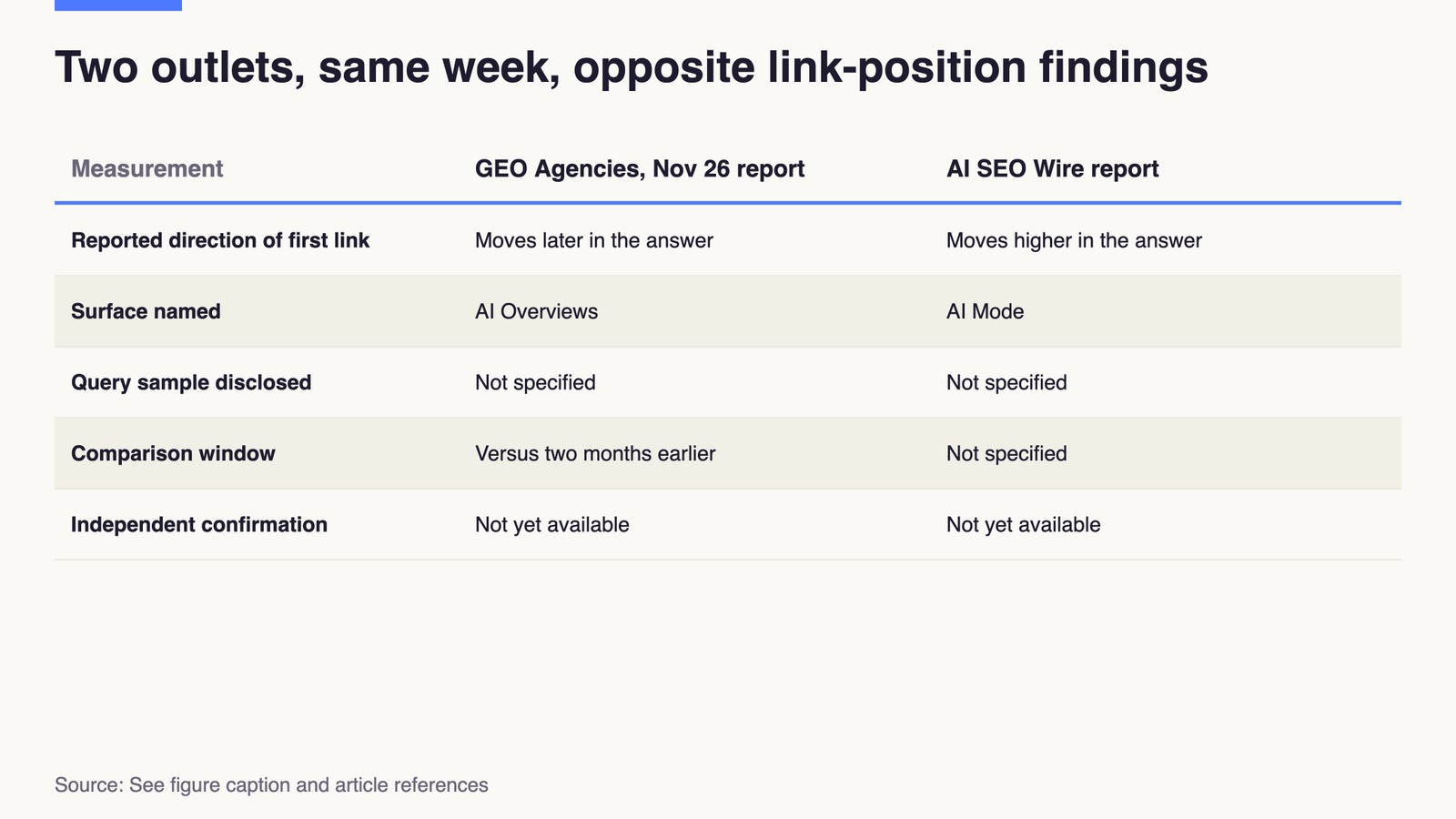
GEO Agencies and AI SEO Wire reached different conclusions about where the first AI-answer link sits, without a shared sample. Method: Direct comparison of the two reports' stated findings on first-link position, surface, and disclosed methodology.
Ranking reports miss some cited pages
Checking organic rankings alone may also miss cited pages. Dunstan Research’s AI Recommendation Study 2026 reported an 88% “disconnect” between Google’s top 10 organic results and conversational-AI recommendations, according to GBP Audit Lab’s wrap-up. It also reported that 46.5% of AI citations came from pages outside Google’s top 50.
Those findings concern conversational AI broadly, not Google’s AI features alone. The supplied summary does not define “disconnect” precisely enough to treat it as the probability that a top-ranking page will miss an AI citation.
A separate Bing analysis examined more than 883,000 AI citations across 26 brands, according to GEO Agencies. It reported that 58% came from pages described as commonly overlooked by brand content teams.
“Overlooked” is the account’s characterization, not a standardized ranking category. The Bing analysis and Dunstan study measure different things. Their percentages should not be combined or treated as confirmation of the same result.
For a publisher auditing the new cards, the practical lesson is to inspect exact URLs rather than rely on a familiar ranking shortlist. Compare cited pages with those already monitored, then record attributable visits separately. That can expose gaps in the dashboard without mistaking a newly discovered citation for a newly acquired reader.
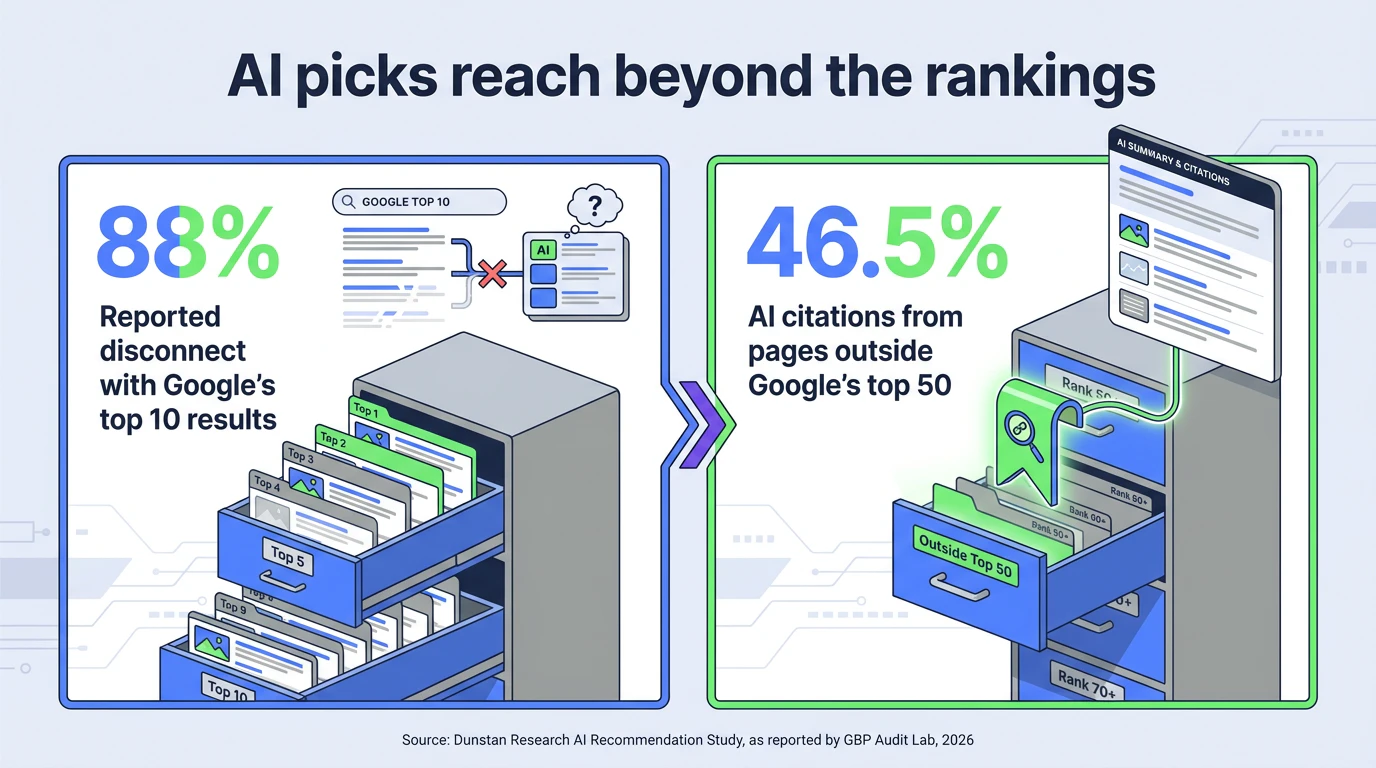
Source: Dunstan Research AI Recommendation Study, as reported by GBP Audit Lab, 2026
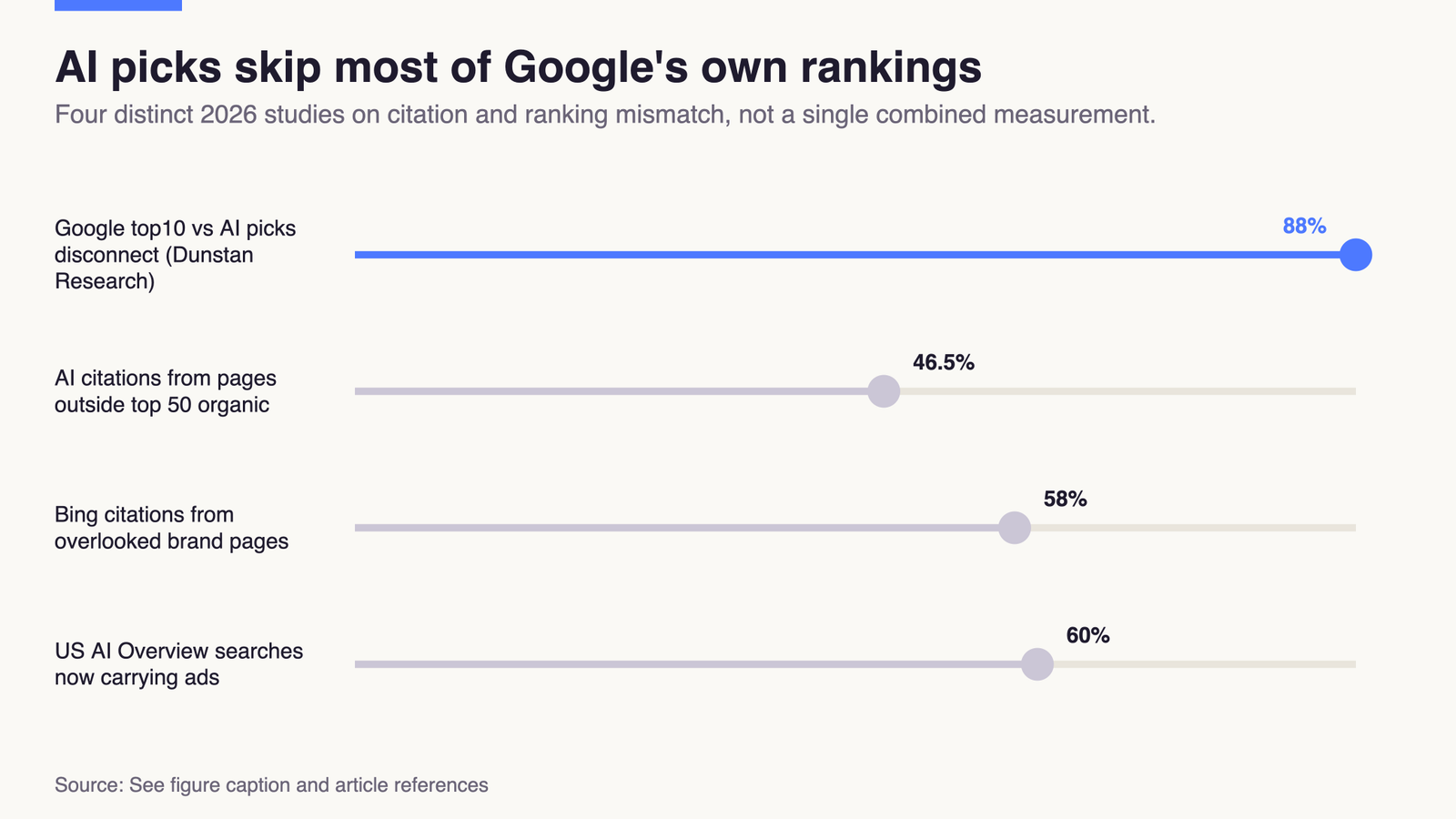
Four separate 2026 studies show how little overlap exists between Google's organic top results, ad placements, and what AI answers actually cite. Method: Each value is the headline percentage reported by a distinct study; studies use different samples and should not be averaged together.
More links still compete for attention
Content format and advertising add further reasons to record what an answer actually shows. Best-of lists accounted for 65% of toy citations in Google’s AI Black Friday answers, according to iPullRank’s finding summarized in AnythingEngineOptimization’s archive. That describes citation share within the toy-shopping sample, not a proven traffic strategy for every publisher.
Separately, Adthena estimated that 60% of US AI Overview searches carried ads, compared with 38% in July 2026, per the archive’s Adthena summary. The difference is 22 percentage points, calculated as 60 minus 38. It measures ad presence, not publisher click losses.
These findings concern different parts of the screen and, in some cases, different products. The end-of-answer cards appeared in some AI Mode answers, according to RankMeTech’s collected reporting. Adthena’s estimate concerns AI Overviews.
A useful layout record should identify the Google experience and log ads, source panels and end cards separately. It should also distinguish citation counts from visits. The supplied findings do not establish that ads displaced citations or caused fewer clicks; that would require evidence connecting the layout to reader behavior.
Five checks before calling a citation a win
Before calling a citation a win, record both the layout and the traffic. Use a fixed query set each week, keeping AI Mode and AI Overviews separate. Log the date, device and market, and save screenshots for comparison.
Include end-of-answer cards such as those described in RankMeTech’s coverage. The five checks below are a proposed recording method, not a test already conducted for this story.
| Check | What to record | What it cannot establish |
|---|---|---|
| First outbound-link position | Location and scroll depth of the first clickable external link; whether opening a panel is necessary. | Earlier placement does not prove more clicks. |
| Total outbound-link count | Links across the full answer, including cards; source-panel links recorded separately. | More links do not establish more visitors or distinct publishers. |
| Card presence | Clickable thumbnail cards, other links and source-panel text, with screenshots. | A larger card does not demonstrate engagement. |
| Answer length | Word count and screenfuls using consistent device settings. | Length alone cannot explain traffic changes. |
| Attributable traffic | Measured visits and the attribution method; mark AI-specific clicks unknown when they cannot be isolated. | General Google referrals cannot establish a citation-to-click conversion rate. |
Check reporting-tool capabilities directly. SEO Weekly’s AI Mode tracker describes a Search Console report that records AI appearances but does not yet count clicks. That capability claim is available here only through the tracker’s summary, not Google documentation.
Denominators matter just as much. AI SEO Wire’s account of Cyrus Shepard’s opt-out test puts the combined outside-click rate for AI Overviews and AI Mode at roughly 0.9%, with a 0.7%–1.1% range. The supplied account describes searches with AI answers as the denominator, rather than appearances of an individual publisher’s citation.
That is an absolute rate, unlike the French study’s relative CTR decline. Neither supplies a publisher’s citation-to-click conversion rate. Leave that field unknown unless the underlying measurements support it.
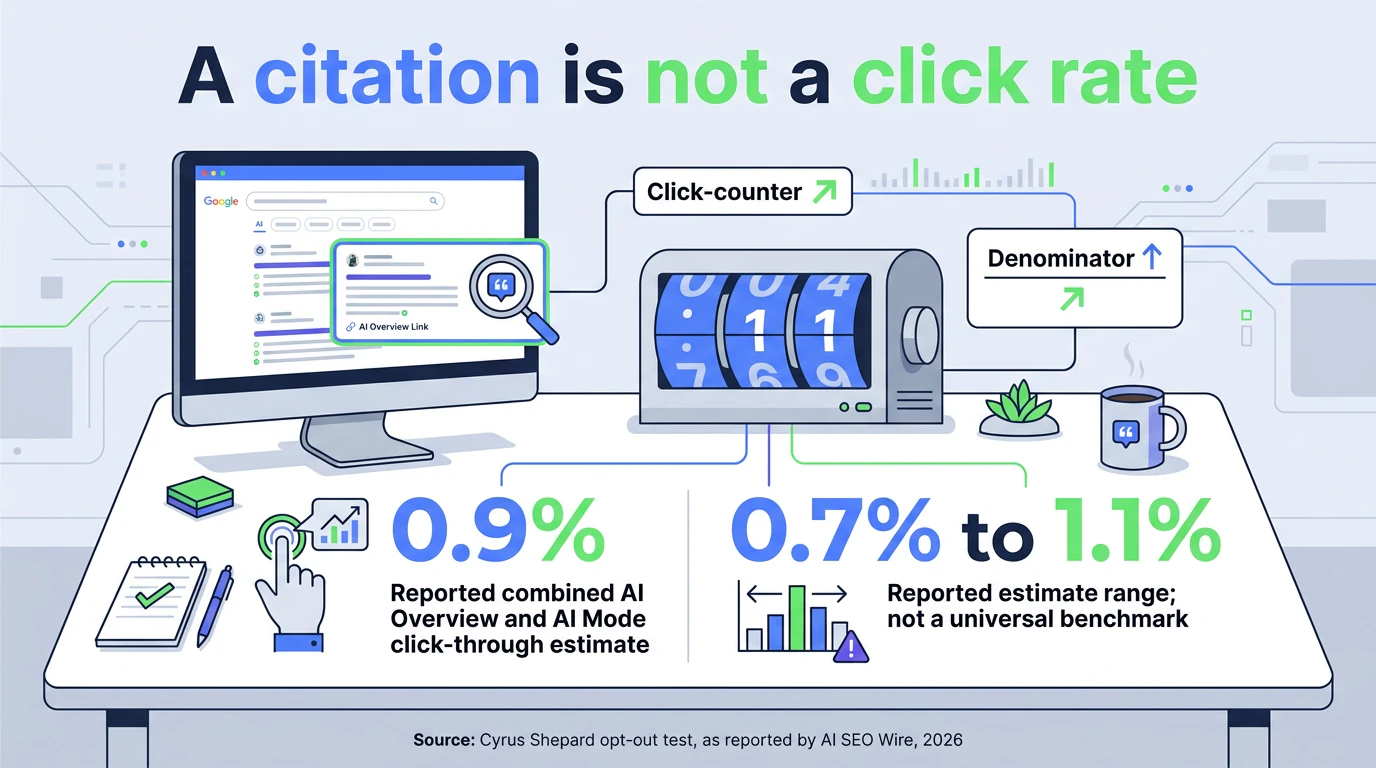
Source: Cyrus Shepard opt-out test, as reported by AI SEO Wire, 2026
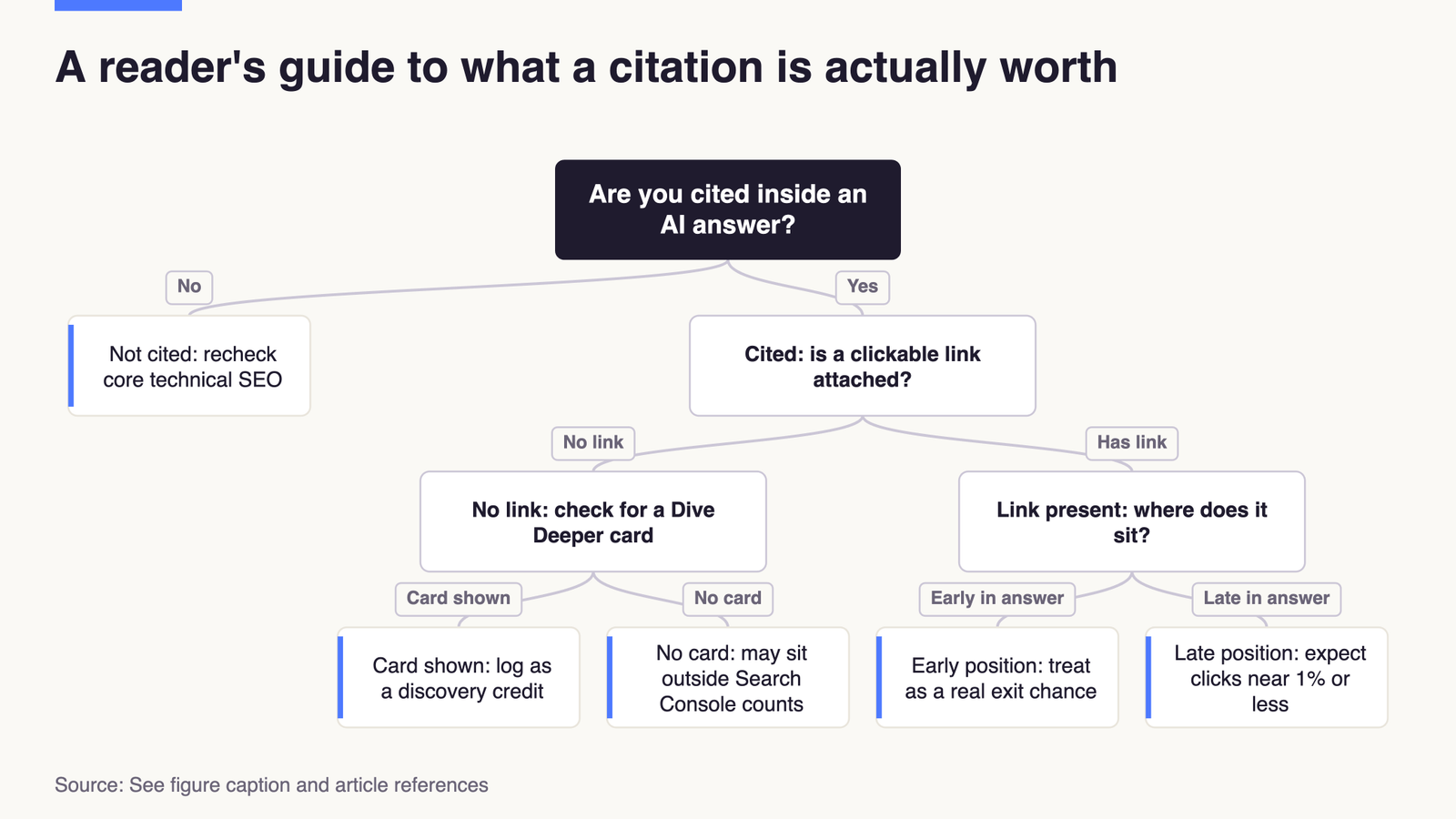
A practical path for judging whether an AI citation represents a real click opportunity or just visibility. Method: Built from the gaps identified across cited reports: whether a link exists, whether a card is shown, and where the first link sits in the answer.
The next useful update needs click data
The next reporting period may bring another complication. Google reportedly pre-announced a December 2026 core update, according to Search Engine Journal. The supplied accounts differ on the November update’s completion timing, so they do not establish a clean before-and-after window for evaluating the cards.
Ranking changes could confound a traffic comparison. If visits rise after a redesign, better rankings may explain some of the increase. A decline would be equally difficult to attribute without tracking those changes alongside the layout.
Watch for broader card availability first. RankMeTech’s account describes “some AI Mode answers,” not a universal default. A wider rollout would expand the opportunity to compare card appearances with measured visits.
Next, look for link-placement reports that publish matched queries, observation dates and clear definitions of position. Comparisons should remain within AI Mode or within AI Overviews before drawing conclusions across them.
Finally, check whether appearance reporting gains a reliable click measure. SEO Weekly’s reported Search Console gap, if confirmed, would leave publishers unable to value an appearance from that report alone.
The evidence that would change this story is a matched record of layout, citations and attributable traffic. Follow the same queries over time, note ranking changes and connect appearances to visits wherever attribution permits. Until then, bigger cards establish more screen space, not more readers.
Limitations
- The supplied evidence contains secondary summaries, not full source articles, original study reports or Google documentation. Claims are attributed to those summaries and have not been independently verified.
- Some archive publication dates precede the observations attributed to them. November dates describe reported sightings, not confirmed global launch dates.
- AI Mode and AI Overviews are different experiences. The cited studies also differ in country, query sample, time window and design, so their estimates cannot be combined.
- No original testing was conducted. The supplied evidence does not measure card presence, link position, answer length and exit clicks together, and cannot establish whether the new cards change traffic.
References
- SEO News This Week: Google, AI Search & Tool Updates | RankMeTech - RankMeTech's weekly SEO news roundup summarizing Google and AI search updates for Nov 18 to 24, 2026. Reported Google's AI Mode Dive Deeper links going live with thumbnails on Nov 23, 2026. Noted Google gave early warning of a December 2026 core update. Logged completion of the November 2026 core update.
- Every story SEO Weekly has covered, written up in full - SEO Weekly's full story archive listing AI-answer and search feature changes. Reported Nov 26 that ChatGPT shows more plain links above its answers for some testers. Said Google's AI answers now show two source panels and tools measuring them may err. Noted Google explained its AI Overview link-selection systems.
- Search Engine Journal - The AI Search & SEO News That Matters - Search Engine Journal's homepage feed of daily AI search and SEO news. Reported the November 2026 core update starting its rollout. Reported Google announcing a December 2026 core update ahead of rollout. Covered Gemini 4 Hydrogen becoming the default AI Mode model.
- AI Mode: news and analysis - SEO Weekly's topic archive tracking all AI Mode product changes since September 2026. Reported the Dive Deeper block appearing in AI Mode with thumbnails on Nov 21, 2026. Noted Search Console's AI-appearance report does not yet count clicks. Cited a study suggesting opting out of AI answers can cost 20% of clicks.
- Weekly SEO Market Wrap-up - GBPAuditLab - GBP Audit Lab's weekly SEO market wrap-up summarizing independent AI search studies. Reported a randomized study finding AI Overviews cut outside clicks by about 40%. Quoted Reddit CEO Steve Huffman on falling Google search referrals. Cited Dunstan Research's finding of an 88% disconnect between Google's top 10 and AI recommendations.
- AI SEO Wire: Google updates, AI search and GEO news - AI SEO Wire's daily feed of Google updates and AI search findings. Reported an opt-out test putting combined AI Overviews and AI Mode CTR near 0.9%. Carried an item stating Google moves AI Mode inline links higher in answers.
- AI-search news archive - AnythingEngineOptimization's dated archive of AI-search research and engine news. Reported Ahrefs found AI Overviews cut CTR 24.4% in France three months after launch. Cited iPullRank finding best-of lists made up 65% of toy citations in Black Friday AI answers. Cited Adthena finding 60% of US AI Overview searches now carry ads, up from 38% in July.
- GEO news: what changed in AI search · GEO Agencies - GEO Agencies' measurement-tagged news feed on AI search changes. Reported Nov 26 that Google now places the first inline AI Overview link later than two months earlier. Reported Ahrefs' 24.4% French CTR drop based on 31,612 keywords. Reported an analysis of 883,000 Bing AI citations finding 58% come from pages brands overlook.