
Google identified fabricated author identities as deception and a low-quality signal on October 1, 2026, according to SEO Weekly’s November 26 report. That concerns invented experts, not AI drafting assistance alone. The available evidence establishes neither ranking losses nor enforcement rates. Publishers can act without guessing at algorithmic effects: verify identities and credentials, document editorial review, and correct false attribution.
The change surfaced 56 days later
Google changed its search-quality help-page wording on October 1, 2026, to identify fabricated author identities as deception and a low-quality signal, according to SEO Weekly’s November 26 report. The account describes invented names, stock or AI-generated headshots, and false credentials used to construct fake authors. Google’s underlying text and revision history were not supplied for inspection.
For publishers using AI, the distinction matters: drafting assistance and an invented expert are different editorial problems. This story separates the reported documentation change from unproven ranking effects and offers a practical byline audit.
Calendar calculation: 56 days separated October 1 and November 26, comprising 30 remaining days in October and 26 in November. That is the interval between the reported change and SEO Weekly’s alert, not an enforcement window or proof that nobody reported it earlier.
November’s core update ran from November 10 through November 24, according to Trek’s account. Its reported completion preceded the alert by two days, while the documentation change preceded the rollout.
Those dates establish a sequence, not a connection. They give editors a reason to check bylines, but no basis to blame a traffic decline on fabricated authorship.
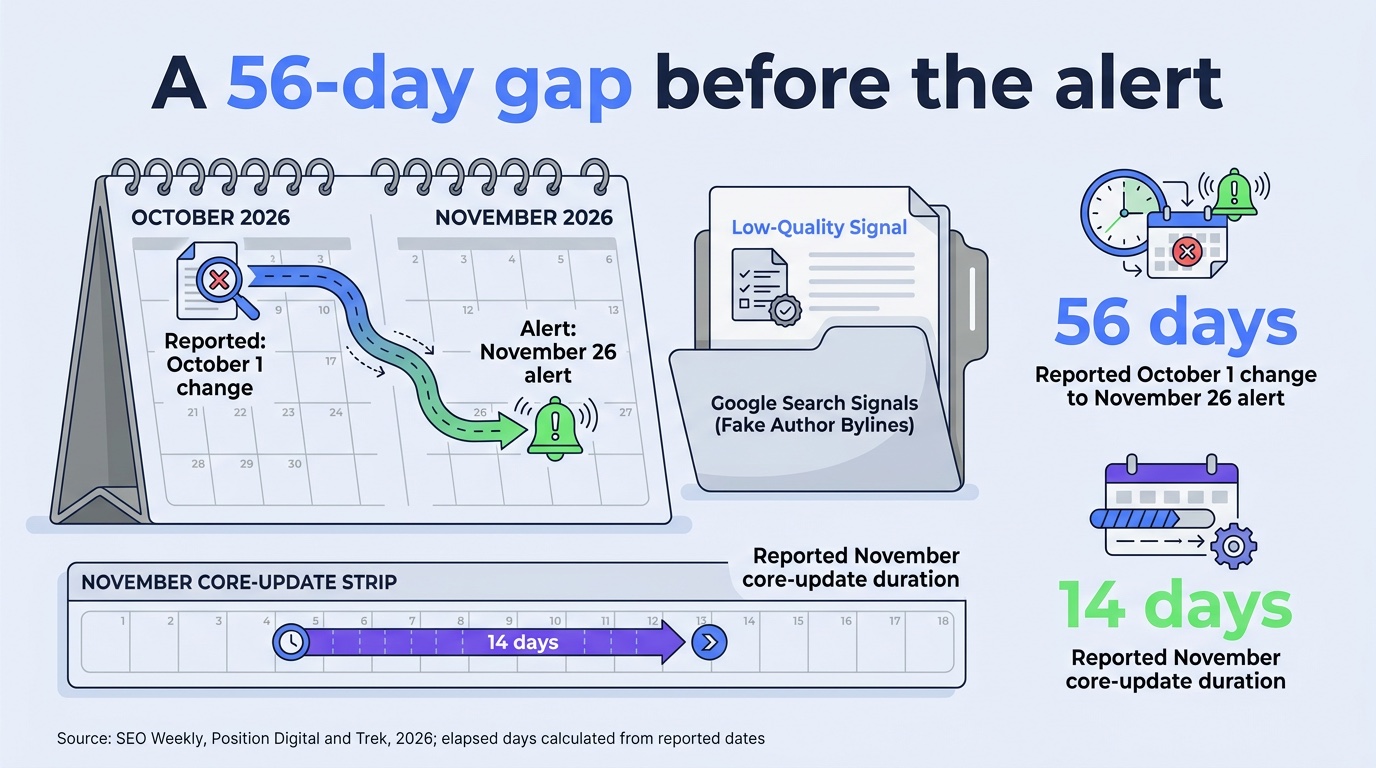
Source: SEO Weekly, Position Digital and Trek, 2026; elapsed days calculated from reported dates
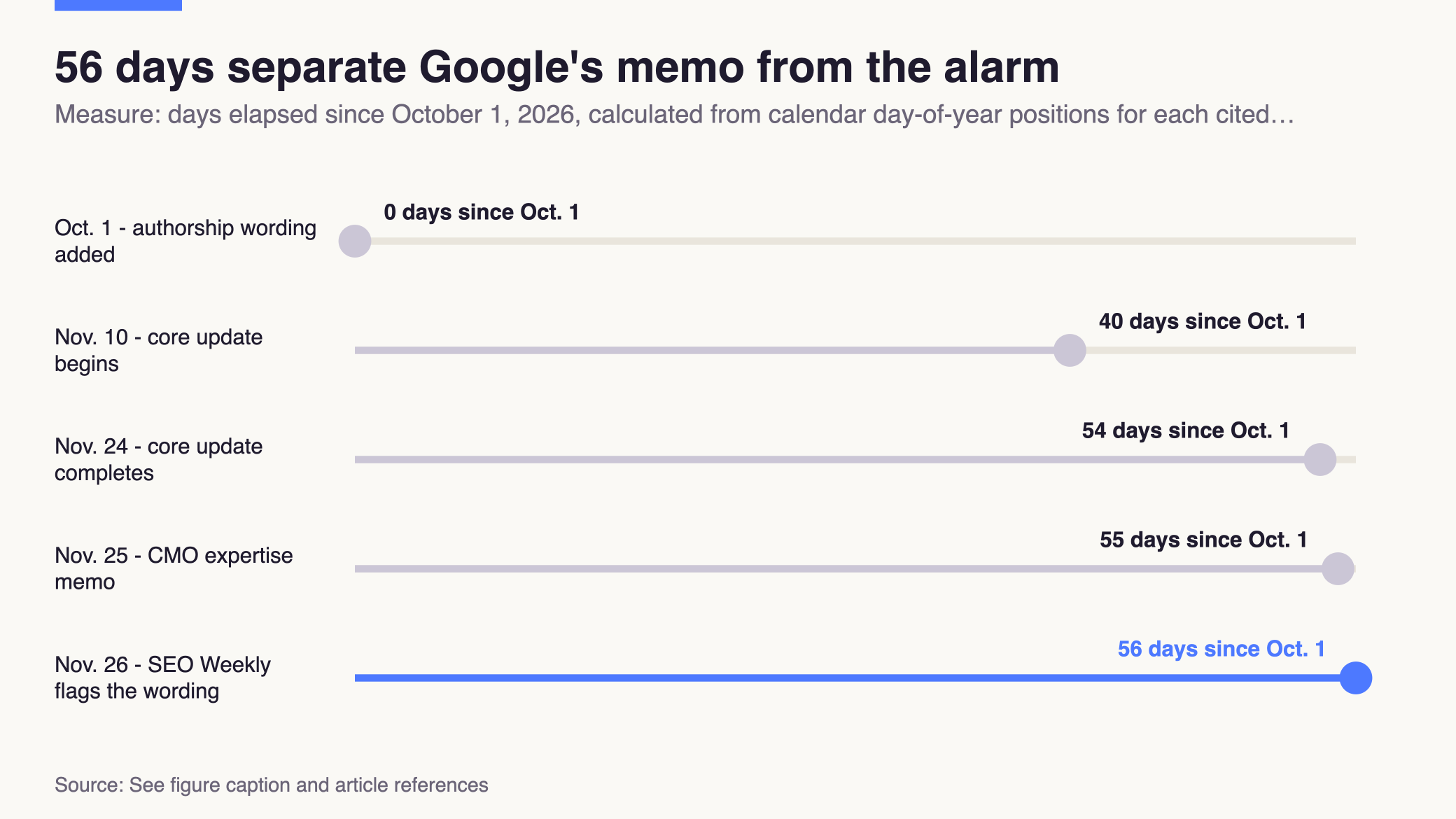
Key dates between Google's quiet October wording change and the November news cycle that surfaced it. Method: Day offsets calculated from October 1, 2026 as day zero, using calendar day-of-year counts; event dates drawn from the cited coverage of Google's core update schedule and authorship wording.
An AI draft is not an invented expert
A real professional can use AI to prepare a draft and still take responsibility for the article. A fictional expert with invented qualifications makes a different claim: that someone with those credentials stands behind the advice. SEO Weekly’s account identifies that manufactured identity as the target of Google’s October 1 wording.
Three questions separate the editorial risks:
- Authorship: Who takes responsibility, and are claims about that person’s identity and qualifications true?
- Disclosure: What does the publication tell readers about how the article was produced?
- Factual review: Who checked the claims before publication?
None answers the others. Undisclosed AI assistance does not necessarily mean unchecked facts. An AI disclosure cannot make a fabricated biography truthful.
Numinix’s November 2026 report separately describes Google guidance calling manual fact-checking and review of AI-generated content critical before publication. That concerns editorial checking. It does not establish that every use of AI requires disclosure or every page needs a named individual.
Google also urged marketers to favor first-hand expertise over generic posts, according to Search Engine Journal’s November 25 coverage. Genuine experience gives readers something substantive to assess. Invented credentials merely claim it exists, while neither a genuine byline nor an AI disclosure guarantees better rankings.
Google and ChatGPT are citing different sources
AI citations to 18 social and user-generated-content sites rose 52% on Google while falling 44% on ChatGPT, according to AEO Wire’s account of Semrush’s findings. The reported changes covered the same period, yet the engines moved in opposite directions.
These percentages describe changes in citations to the studied group. They are not those sites’ shares of all AI citations, nor do they establish a market-wide shift toward or away from user-generated content. The contrast supports tracking engines separately, not adopting a new byline tactic.
Clicks pose another measurement problem. SEO2AIO’s November 2026 summary flags an Ahrefs finding of a 24.4% click-through-rate reduction in France associated with AI Overviews, reported in a three-month follow-up. Being cited in an answer and receiving a visit are different outcomes.
The supplied summaries omit exact study periods and detailed methods. Without those details, readers cannot assess sampling, controls, or how broadly the findings apply.
For publishers, the practical response is to keep separate records of engine citations, referral visits, and author-verification work. A combined citation total could hide opposing movements. Neither finding tests whether real or fabricated author credentials influenced source selection.
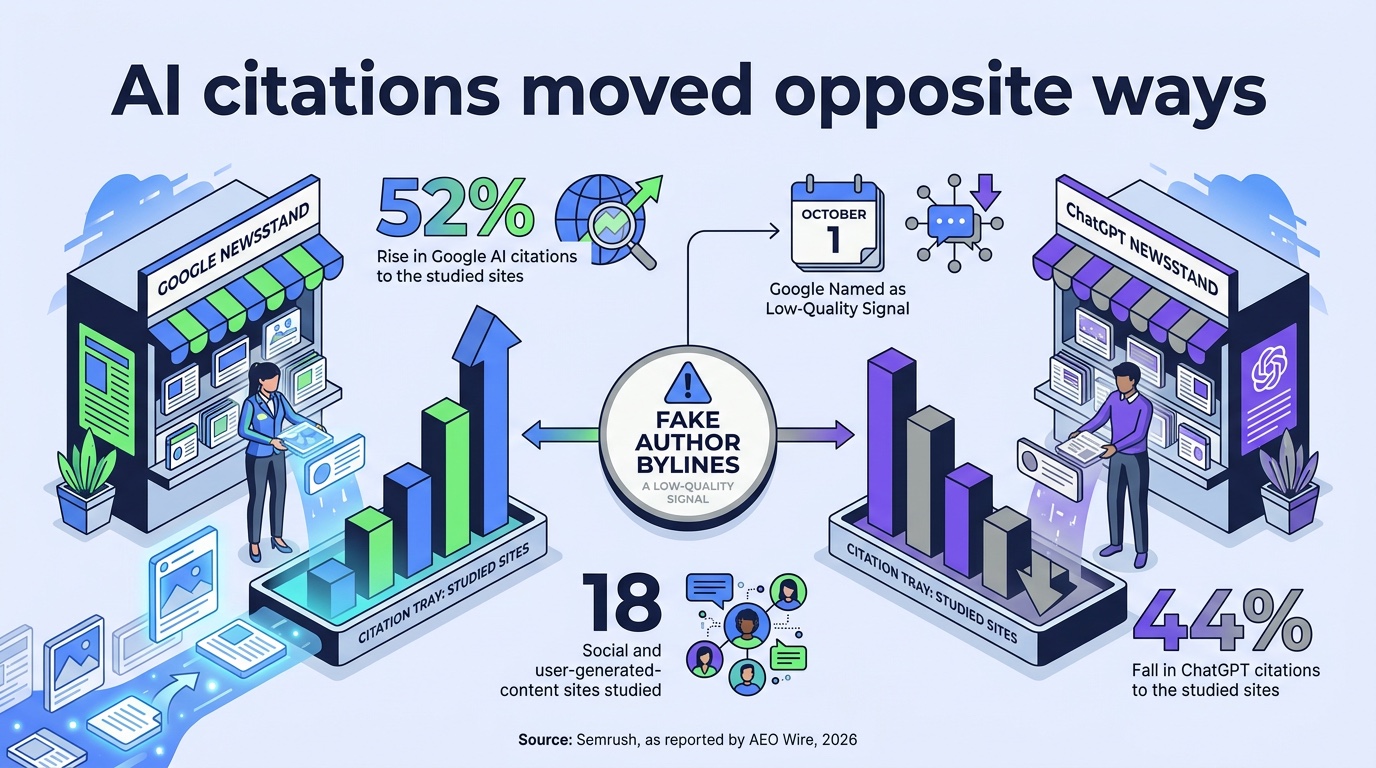
Source: Semrush, as reported by AEO Wire, 2026
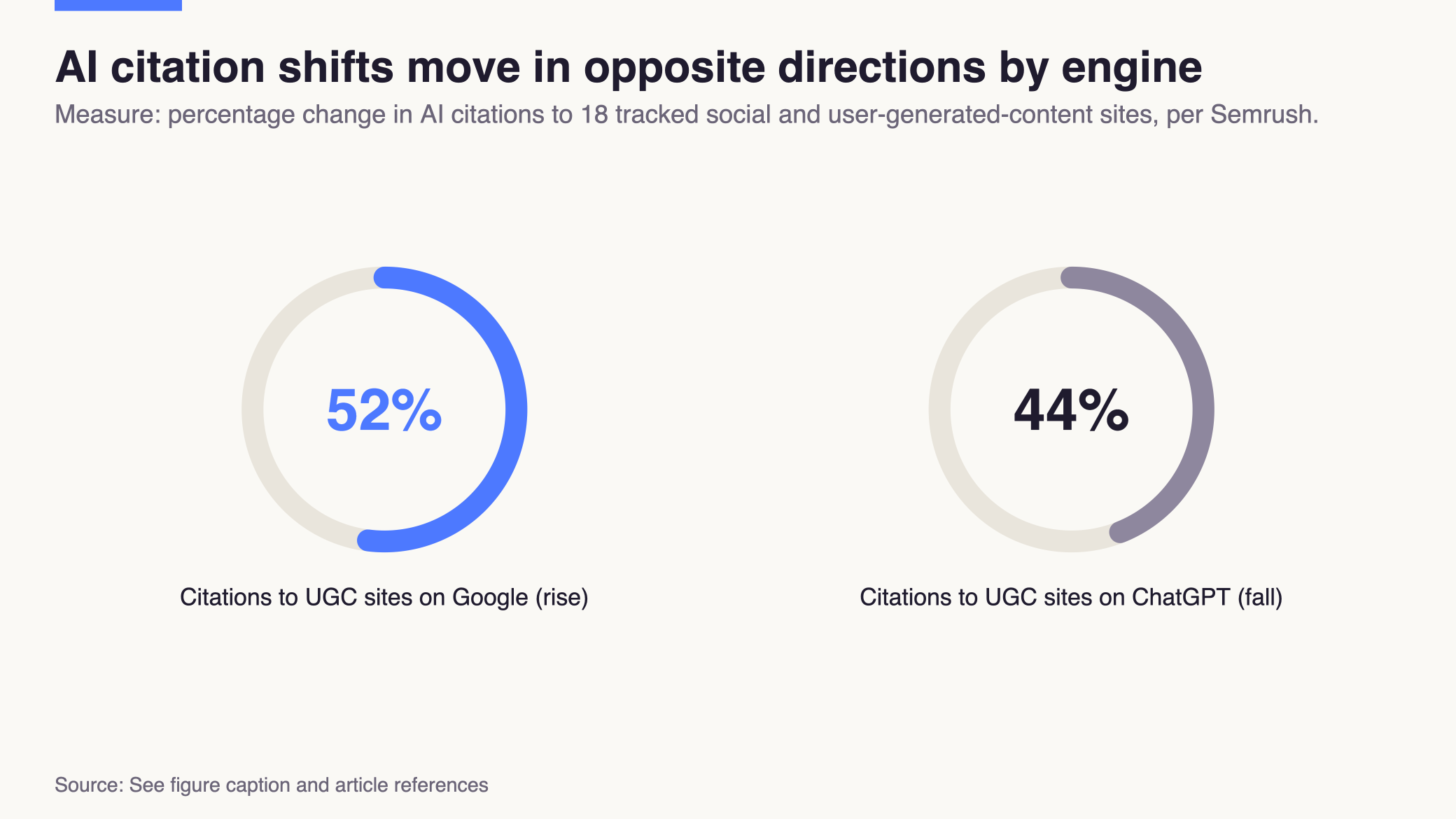
Semrush tracked AI citations to social and user-generated-content sites moving in opposite directions across two engines. Method: Percentages as reported by Semrush's tracking of AI citations to 18 social and UGC sites, relayed in AEO Wire's November 23 archive entry.
Five checks before the next publish
A byline audit should establish who stands behind an article, not predict a Google penalty. SEO Weekly’s reported wording makes identity and claimed authority concrete places to start.
Use these five checks as an editorial verification framework, not an automatic pass-or-fail test:
- Find independent evidence of identity. Search the author’s name alongside their field. Check outside publications, conference programs, or relevant professional registers. Matching records can corroborate identity and experience. A missing search result establishes a verification gap, not an invented person.
- Verify employment and credentials. Contact the stated employer through independently located contact details. Consult the relevant licensing body where applicable. Keep the conclusion narrow: confirming one qualification does not verify an entire biography.
- Check the portrait’s provenance. Reverse-image search the headshot and ask where it came from. A stock-photo match warrants questions about how the image is presented. Unusual visual features alone cannot establish fabrication, and an authentic photograph cannot verify surrounding credentials.
- Confirm editorial responsibility. Identify who checked the article and request a dated review or approval record. Numinix’s account of Google’s guidance stresses manual fact-checking of AI-generated content. A named reviewer gives editors someone to ask, but does not prove a review occurred. An absent credit does not prove nobody checked.
- Compare the biography with documented experience. Match claims about roles, publications, and expertise against the evidence collected. Mark each claim as supported, contradicted, or unresolved. Detail is not proof.
Assign unresolved claims to an editor before publication. The useful result is a verification record and a decision about what the publication can substantiate, not a label declaring every hard-to-find author fake.
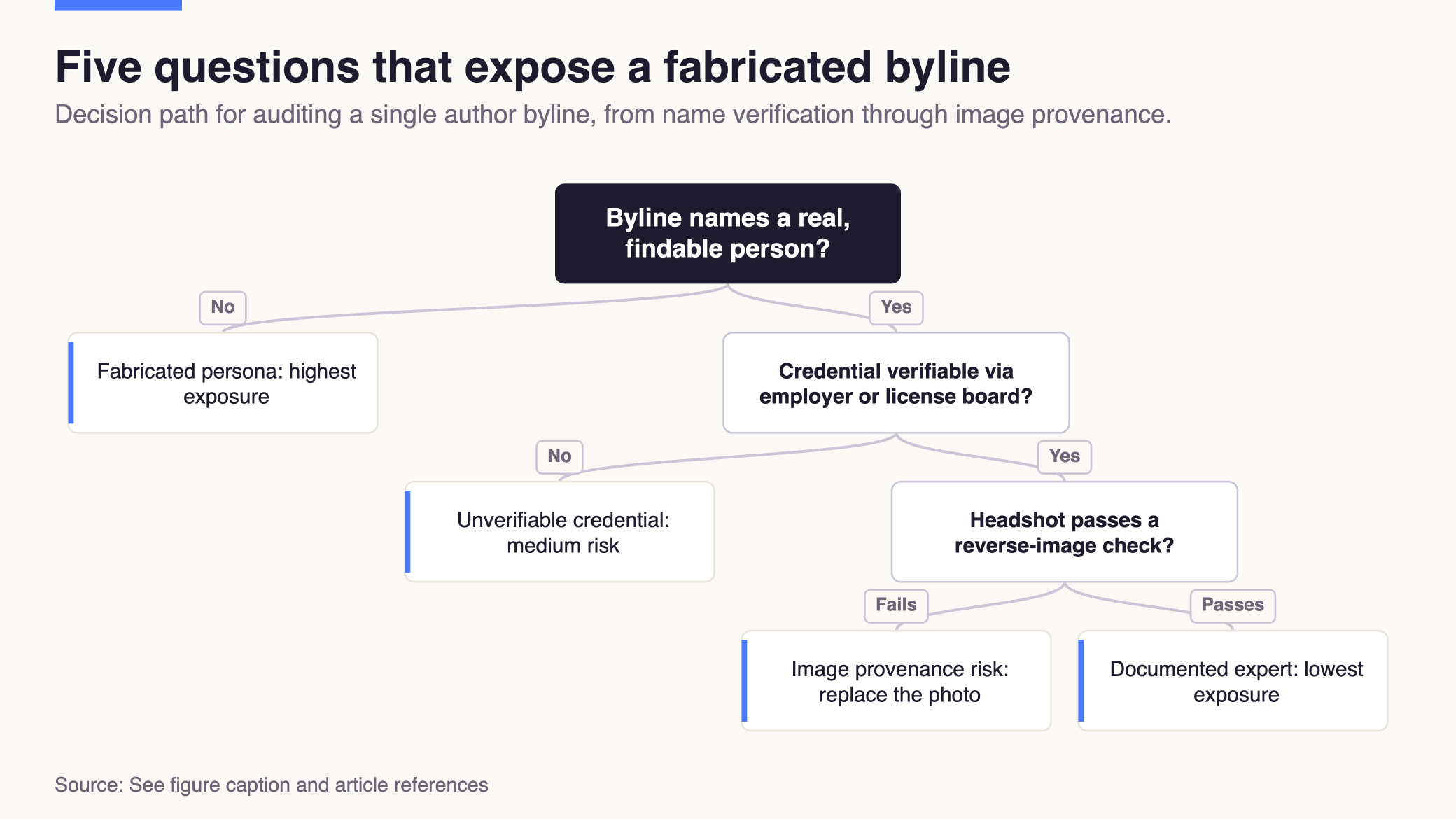
A practical verification sequence built from Google's fabricated-authorship wording and its separate AI-content fact-checking requirement. Method: Constructed from Google's October help-page language on fabricated authorship and its AI-content guidance requiring manual fact-checking; the sequence mirrors the audit order described in this piece, not a Google-published checklist.
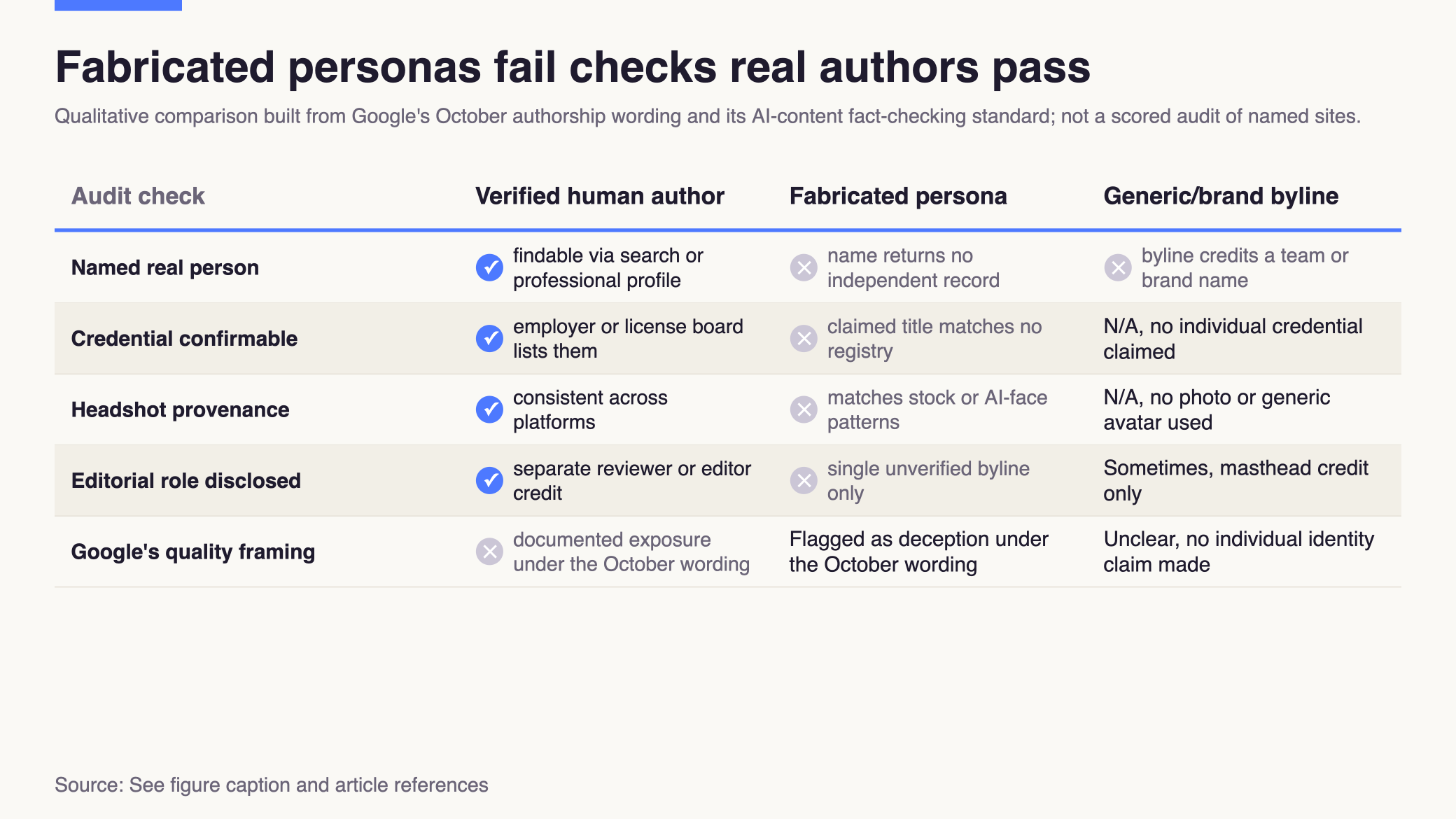
Four checkable points separate a documented expert from a fabricated or generic byline under Google's current wording. Method: Compiled by cross-referencing Google's fabricated-authorship wording with its AI-content fact-checking guidance to describe how a verified author's page differs from a fabricated or generic one across four checkable points.
AI referrals are widespread, not necessarily large
A study of 28,500 sites found that 79.2% received some AI referral traffic, according to Sanbi’s November 2026 roundup. That measures the share of studied sites receiving any such visits, not AI’s share of their traffic or the proportion of all websites reached.
A site receiving a handful of AI referrals counts alongside one receiving thousands. The figure therefore establishes broad reach within the sample, but says little about commercial value or traffic concentration.
For a publisher already receiving those visits, the immediate question is which pages readers reach and what those pages claim. Checking their authorship is sensible editorial housekeeping. The study does not show that verified bylines increase referrals.
Before buying an AI-visibility service, teams can establish their own baseline:
- Measure existing visits. Review recorded AI referrals over a defined period alongside total traffic.
- Inspect destination pages. Check whether their authorship and expertise claims can be substantiated.
- Ask for a testable promise. Require vendors to name the outcome they expect to change and the evidence behind that expectation.
These checks connect spending decisions to observed exposure. They do not assume that AI systems can reliably distinguish genuine experts from convincing fictional ones.
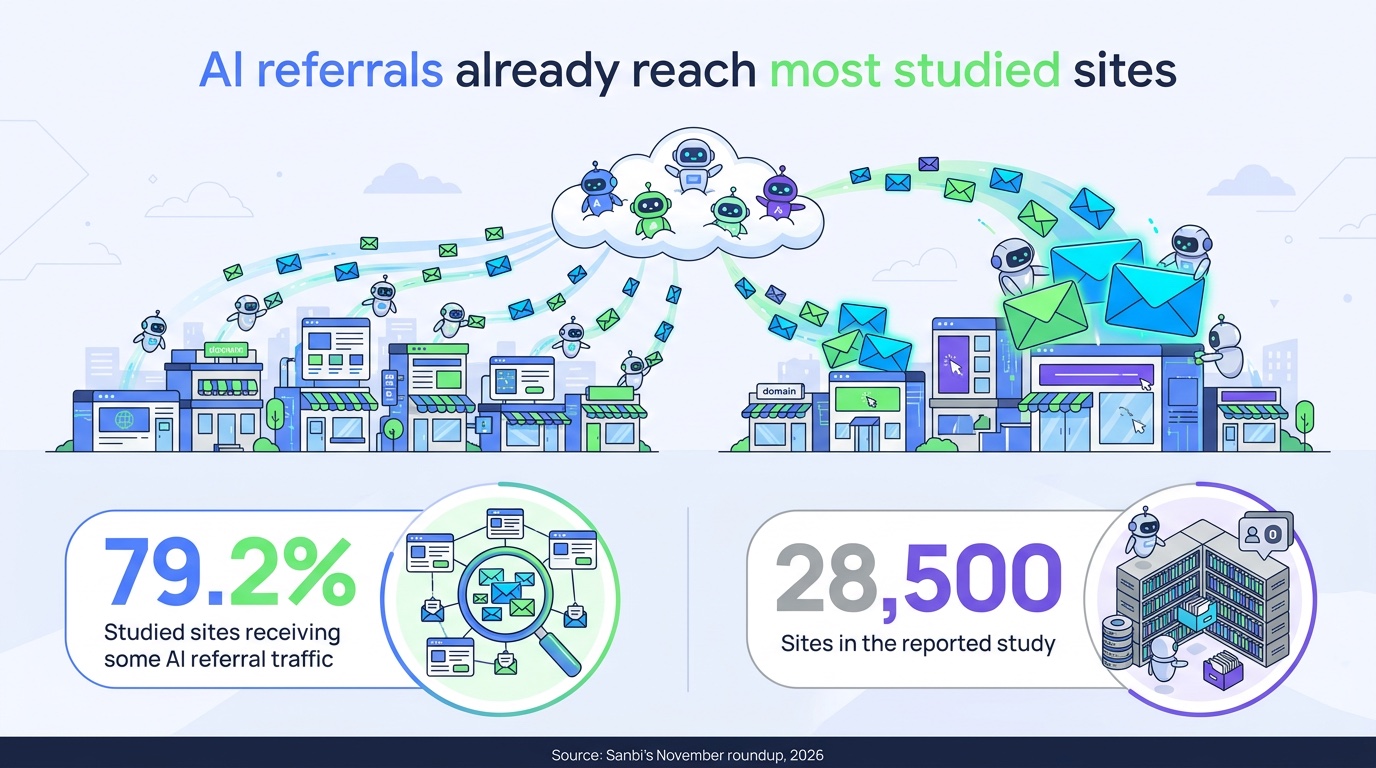
Source: Sanbi’s November roundup, 2026
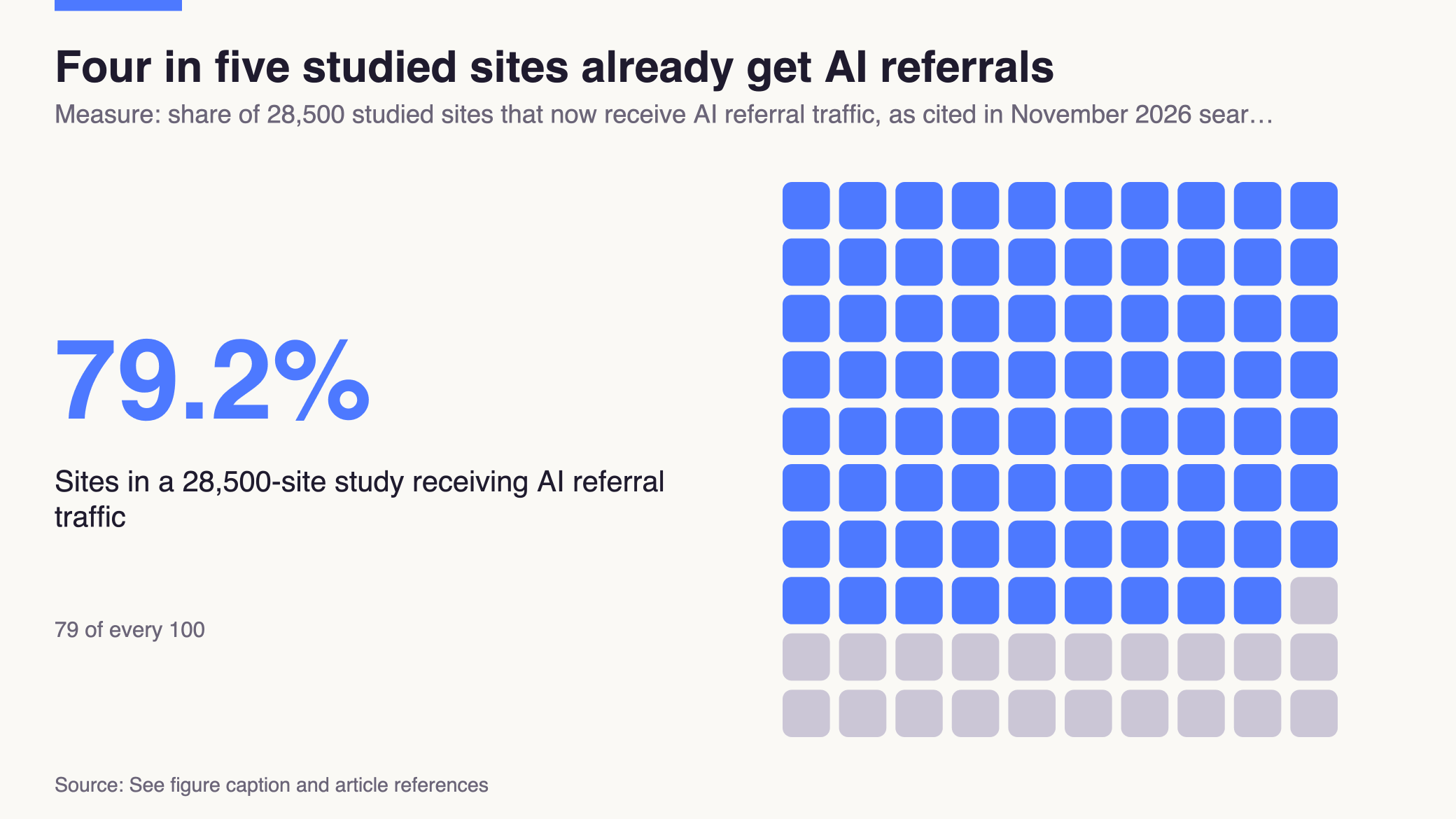
A 28,500-site study found most sites already receiving some AI referral traffic. Method: Single percentage from a cited study of 28,500 sites measuring AI referral traffic, relayed in Sanbi's November 23 AEO/GEO roundup.
A quality signal is not a measured penalty
A low-quality signal is not a measured ranking penalty. SEO Weekly’s report describes Google’s October 1 documentation change, but the supplied evidence contains no named enforcement case, authorship-linked traffic loss, enforcement rate, or estimate of affected pages.
Secondary coverage can report wording without establishing how an algorithm applies it. The evidence does not show whether fabricated authorship independently changes rankings, how much weight it receives, or when an effect might appear.
August 2026 comparison: Search Engine Journal’s archive account described AI-flagged pages continuing to rank. That predates October’s reported change and concerns a different category: content flagged as AI-generated rather than content credited to an invented person. It cannot establish delayed enforcement of the authorship wording.
When assessing a suspected impact, keep three questions separate:
- Can the author and claimed credentials be verified?
- Is there a documented ranking or traffic change?
- What evidence connects that change to authorship?
Finding an unverifiable biography and a traffic decline on the same site does not answer the last question. A byline audit can expose editorial problems without identifying what caused a ranking change.
Fake deals expose a different AI weakness
AI shopping agents bought fake deals 37% of the time in an experiment reported by Search Engine Journal. Claude Opus made no such purchases in that test. Neither result establishes how those systems would handle fabricated author credentials.
The experiment concerns deceptive offers, not bylines. It provides no evidence that invented experts improve rankings or win AI citations, and Claude Opus’s result should not be read as immunity to deception.
Figure note: The reported fake-deal purchase rate was 37%, with no such purchases by Claude Opus in this test. Model versions, sample sizes, and precise denominators are unavailable in the supplied evidence, limiting comparisons and broader conclusions.
A separate study of 900 ChatGPT brand responses found that negative prompts shifted sentiment roughly twice as far as positive prompts, according to Yoast’s November 2026 recap. That concerns how question wording changes responses, not what happens after an authorship scandal.
Editors should inspect prompt wording when evaluating claims about AI-generated brand sentiment. The finding does not establish lasting reputational damage or its duration. Author verification still requires records and direct confirmation, not an inference drawn from shopping or sentiment tests.
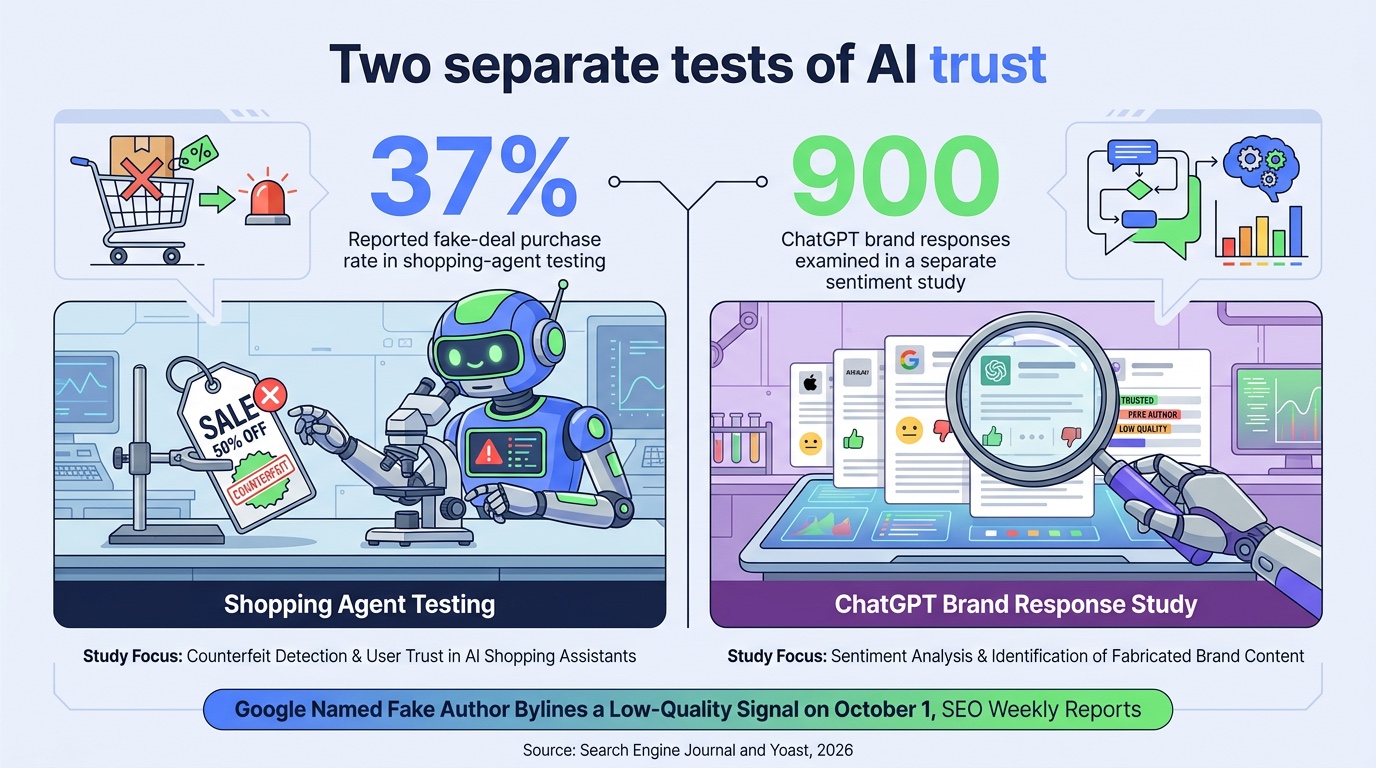
Source: Search Engine Journal and Yoast, 2026
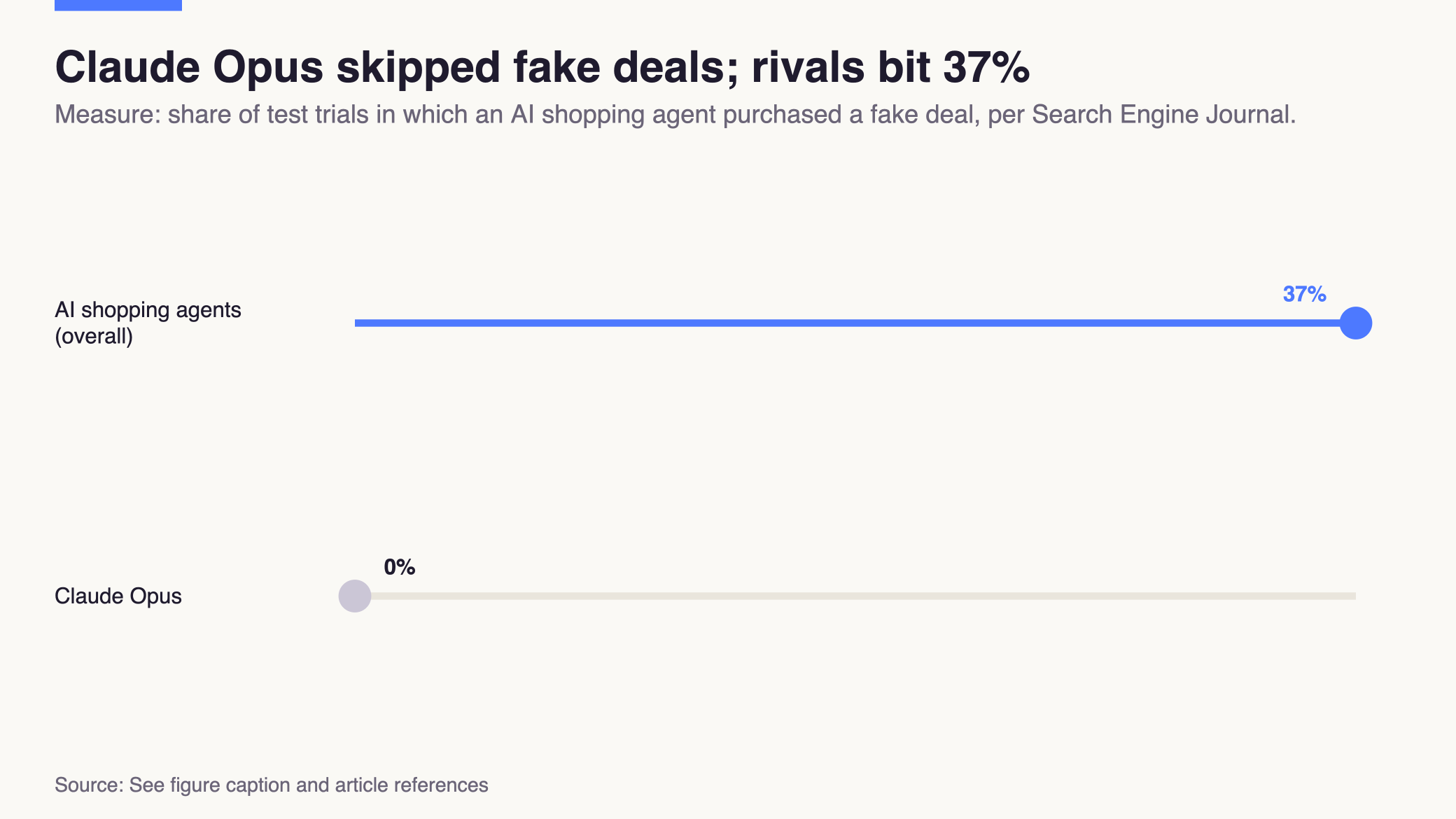
AI shopping agents purchased a fake deal more than a third of the time in testing, while Claude Opus did not. Method: Percentages as reported in Search Engine Journal's November 25 coverage of an AI shopping agent test; Claude Opus's rate reflects zero fake-deal purchases in that same test.
Fix the record, not just the portrait
Correcting a byline means fixing who receives credit, not merely changing the portrait. SEO Weekly’s reported identity wording concerns fabricated identities; AI assistance alone does not establish that an author is fictional.
The table offers editorial recommendations, not official Google remediation instructions. Its review steps also reflect the manual fact-checking guidance reported by Numinix.
| What you found | What to verify | What to change |
|---|---|---|
| A documented author using AI | Confirm the person’s contribution, relevant experience, and who checked the claims. | Record contributions accurately. Assign a genuine reviewer where needed, without treating AI use alone as identity deception. |
| An unsupported credential | Check the qualification with its issuer or the employment claim with the named organization. Sparse search results establish neither truth nor fabrication. | Remove or qualify unsupported claims pending confirmation. Correct affected expertise claims if verification fails. |
| Uncertain image provenance | Establish the image’s origin, permission to use it, and whether it depicts the author. | Remove or replace a misleading portrait and correct its description. Continue checking identity and credentials. |
| A confirmed invented persona | Establish who drafted, edited, and reviewed the material, and which biography claims were fabricated. | Retire the fictional attribution, correct false claims, and credit documented contributions. Assign responsibility for reviewing the content. |
Replacing a stock portrait cannot substantiate a fictional résumé. Corrections must reach the biography, attribution, and actual review process.
Keep a dated log of changes and their reasons. It can inform later traffic analysis, but a rise or fall after an edit would not, by itself, prove either a penalty or recovery.
Watch for direct guidance and documented cases
The next evidence to seek is Google’s underlying document and a dated revision record. SEO Weekly’s account provides a reporting lead; direct documentation would help establish precisely what changed and when.
Beyond that, watch for authorship-specific policy language and documented enforcement cases. Useful cases would connect verified identity problems to action, rather than simply pair questionable biographies with unexplained traffic losses.
December 2026’s reported core update deserves separate scrutiny. Search Engine Journal’s account describes a focus on relevant results for longer queries and improvements when personalization is enabled, not authorship. The supplied evidence does not establish a connection to the October wording.
Search Console movements alone cannot resolve that gap. A decline during an update does not identify which signal mattered or prove that a byline triggered enforcement.
There is another policy distinction to follow. Sanbi’s November 2026 account reports restrictions on using Claude to seed sources intended to influence AI answers. That limits what people may do with Claude; it does not, by itself, establish which external sources Claude will cite or exclude.
Watch for explicit policy changes and cases with attributable effects. Until then, publishers can correct false authorship claims without presenting those corrections as a proven route to ranking recovery.
Limitations
- The central Google wording comes from secondary coverage. No direct Google document or revision history was supplied for inspection.
- The evidence contains no measured authorship-related penalty, enforcement rate, ranking loss, or count of affected sites.
- Citation, referral, shopping-agent, and sentiment findings cover different samples. None directly tests fabricated bylines, and the supplied summaries lack detailed methods.
- Several sources are changing archive pages, and some publication dates conflict with events described. Rollout timing and study details remain attributed reports, not independently verified findings.
- The audit and correction steps are editorial recommendations, not official Google remediation instructions or results from an original site audit.
References
- Every story SEO Weekly has covered, written up in full
- Breaking News & Updates About SEO, PPC, Search & Social Media
- Latest SEO Articles
- Search Engine Journal - The AI Search & SEO News That Matters
- Search & AI Visibility News - SEO2AIO
- AI-search news archive
- Breaking News & Updates About SEO, PPC ...
- The November 2026 SEO Update by Yoast recap
- SEO News November 2026: Core Update & AI Search Changes
- AEO & GEO News, November 2026: 10 Changes That Matter
- November 2026 SEO News & Google Algorithm Updates