
Google’s November 10, 2026 core update overlapped a November 12 AI Mode model switch and three days of undercounted generative-AI impressions in Search Console, according to the supplied industry reporting. A single visibility chart cannot distinguish those changes. Before rewriting pages, check report completeness, independent rankings, AI citations and server logs. Monitoring tools also lost data or changed coverage during November, while secondary accounts disagreed on when the core rollout ended.
Three changes, one confusing chart
Google began its third core update of 2026 on November 10, according to ExtCafe’s account of Google’s Search Status Dashboard. The launch overlapped a worldwide AI Mode model switch and a three-day Search Console reporting gap.
For anyone deciding whether to rewrite a page, those are different problems. This account separates ranking movement, AI source citations and missing measurements, then adds a less obvious complication: independent monitoring tools changed or lost data too. No supplied domain-level comparison establishes what caused an individual site’s loss.
On November 12, Google made Gemini 4 Hydrogen the default model in AI Mode worldwide, according to Coach Bob McCranie’s weekly coverage. Any change in the pages cited by AI answers therefore needs checking separately from conventional search positions.
Search Console had already undercounted AI Overview and AI Mode impressions during November 9–11, per Sanbi’s roundup. Missing reported impressions are not proof of missing visibility.
The overlap figure puts these windows on one timeline. It is a guide to what to check first, not evidence that the events had the same effect.
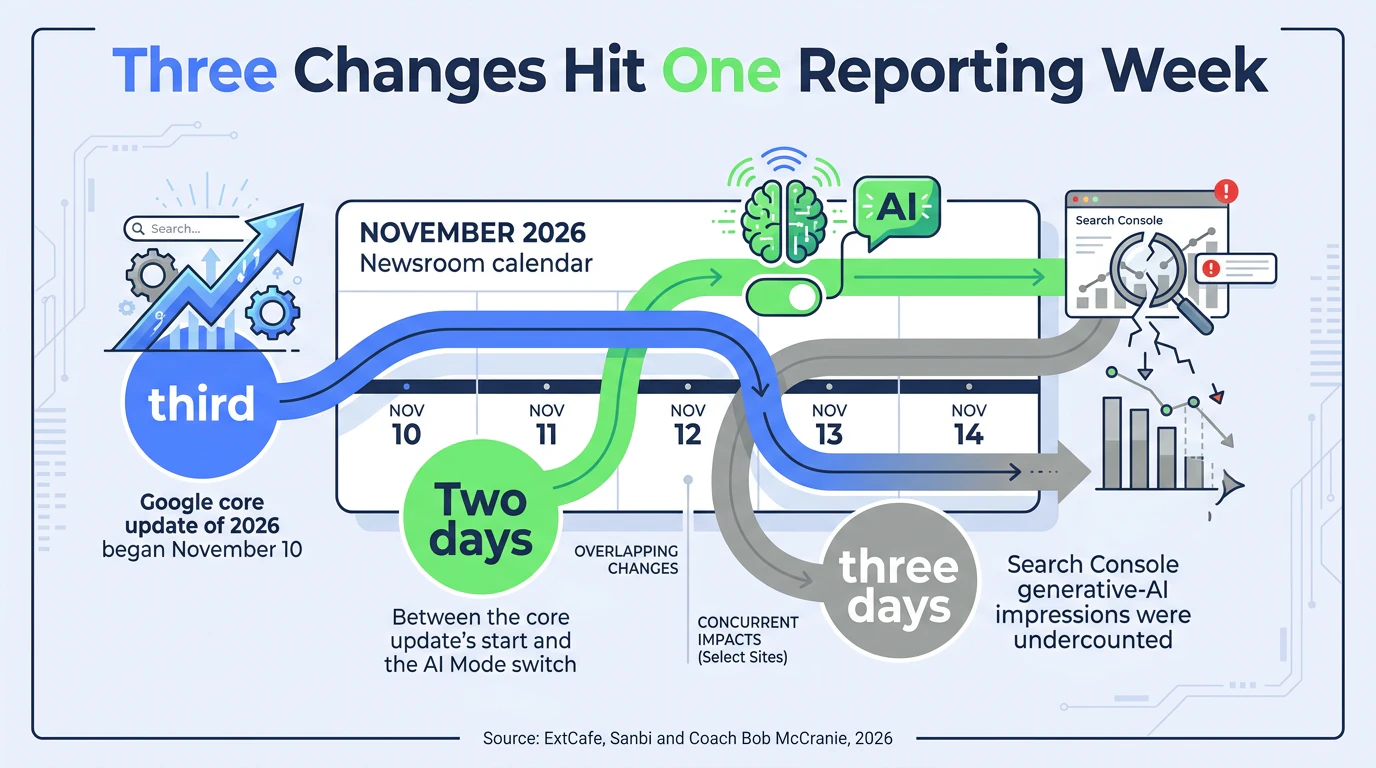
Source: ExtCafe, Sanbi and Coach Bob McCranie, 2026
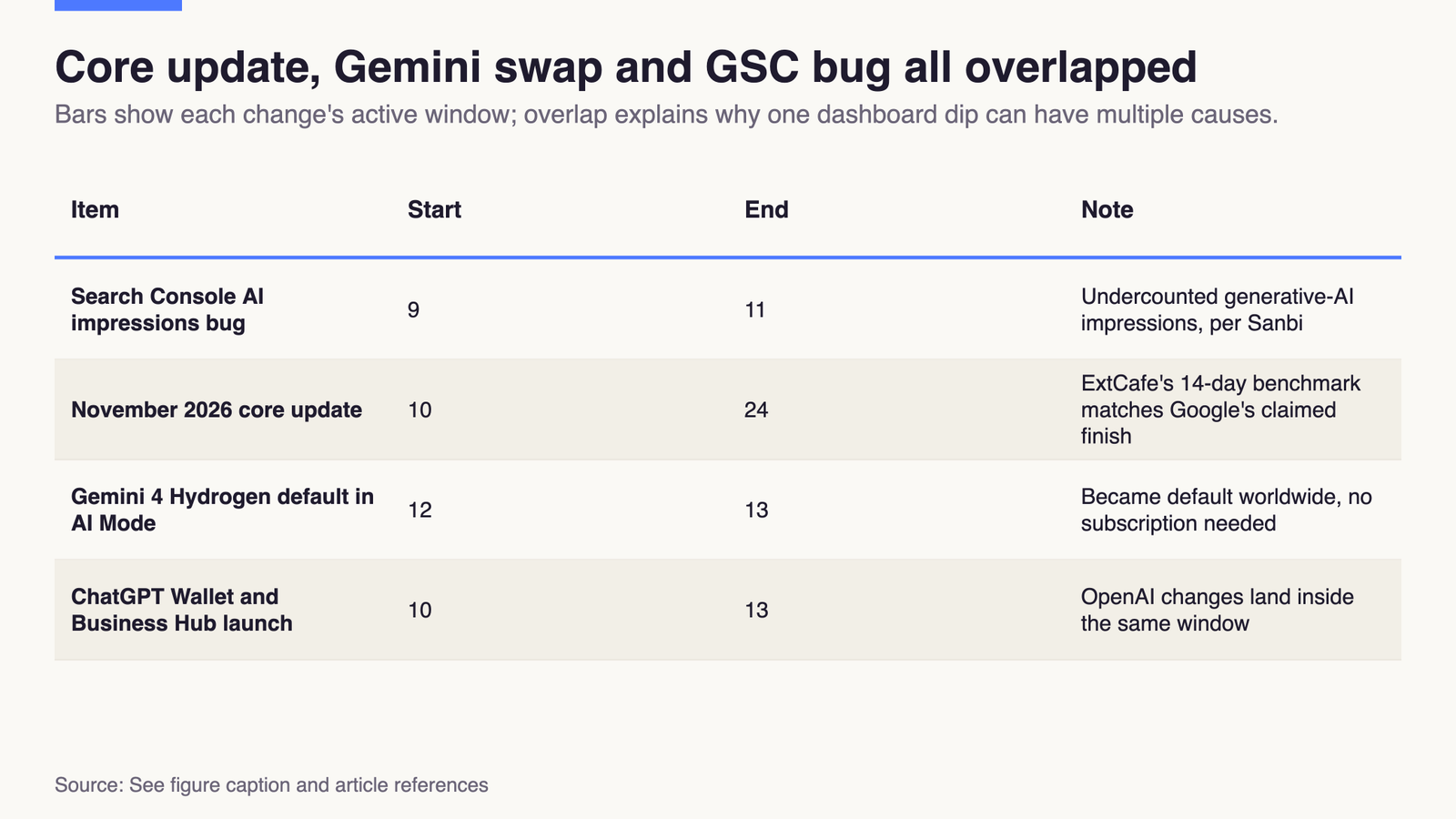
Four November changes landed inside the same ten-day window, which is why a single visibility dashboard can carry three or four causes at once. Method: Start and end days are drawn from dated trade-press reporting on each event and converted to day-of-November for a shared axis; the core update's end reflects its reported completion claim, not an independently measured finish.
The week, date by date
The central changes arrived November 9–12. November 13–14 provides follow-up observation days, not an established endpoint for the core rollout.
- November 9: the reporting gap began. Search Console’s Generative AI report undercounted AI Overview and AI Mode impressions through November 11, according to Sanbi. That gap limits what those impression totals can tell readers.
- November 10: the core update started. This changed Google’s organic ranking systems, distinct from the reporting problem. ExtCafe dates the rollout’s start and says Google’s dashboard still listed it as in progress when checked.
- November 11: Google warned about access barriers. Webvello’s timeline records a warning that content delivery network challenge pages could cause pages to drop from Search. The warning itself was not a new ranking event or evidence of a particular site’s traffic loss.
- November 12: AI Mode’s default model changed. Gemini 4 Hydrogen became the default for signed-in and signed-out users, according to McCranie’s coverage.
That’s AEO Bro’s roundup also places the model switch on November 12. Agreement on that date helps anchor the comparison, but does not identify which change affected a website.
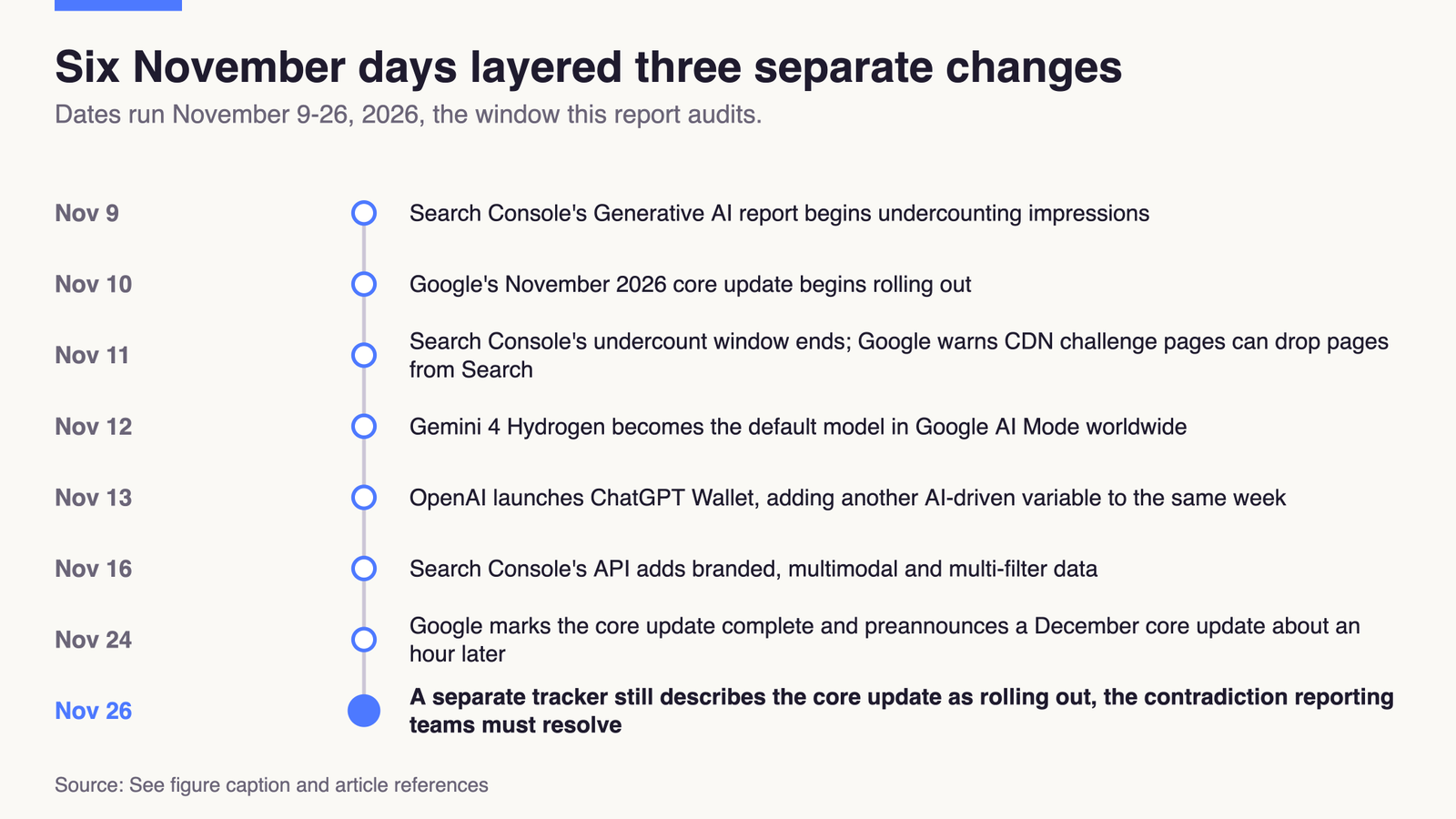
From a quiet Search Console bug to a contested core-update finish line, each dated event narrows the window for any single explanation. Method: Dates compiled from multiple dated trade-press sources covering the same week, cross-checked where more than one outlet reported the same event.
Audit the numbers before the pages
Start with the affected metric. Sanbi’s November review recommends excluding November 9–11 generative-AI impressions from comparisons. The reported problem concerned those impressions, not every Search Console metric. It does not establish that clicks or ordinary organic rankings fell.
Calendar arithmetic: 3 / 30 = 10% of November’s days. That is not 10% of impressions or traffic. The supplied evidence does not quantify the undercount or those dates’ share of activity.
A cleaner comparison should:
- Exclude the affected dates from the generative-AI impression series and label the omission.
- Use equal-length, unaffected windows with similar weekday coverage.
- Keep pages, countries and report categories consistent.
- Preserve the original export alongside the adjusted comparison.
Independent tracking needs its own audit. On November 18, Nozzle collected 11.6% of its normal search-results-page volume during ten hours, according to AEO Sherpa. That describes collection volume, not a ranking decline.
If missing results differ from those collected, the reduced sample could distort a volatility reading. Check coverage before interpreting either a sudden jump or an unusually quiet stretch.
Report definitions also changed. DevakaTalk’s tracker says Search Console added worldwide splits for AI Overview, AI Mode and Discover generative-AI impressions by page, country and date. The supplied account does not establish an effect on totals, but it gives analysts another reason to check that exports use matching definitions.
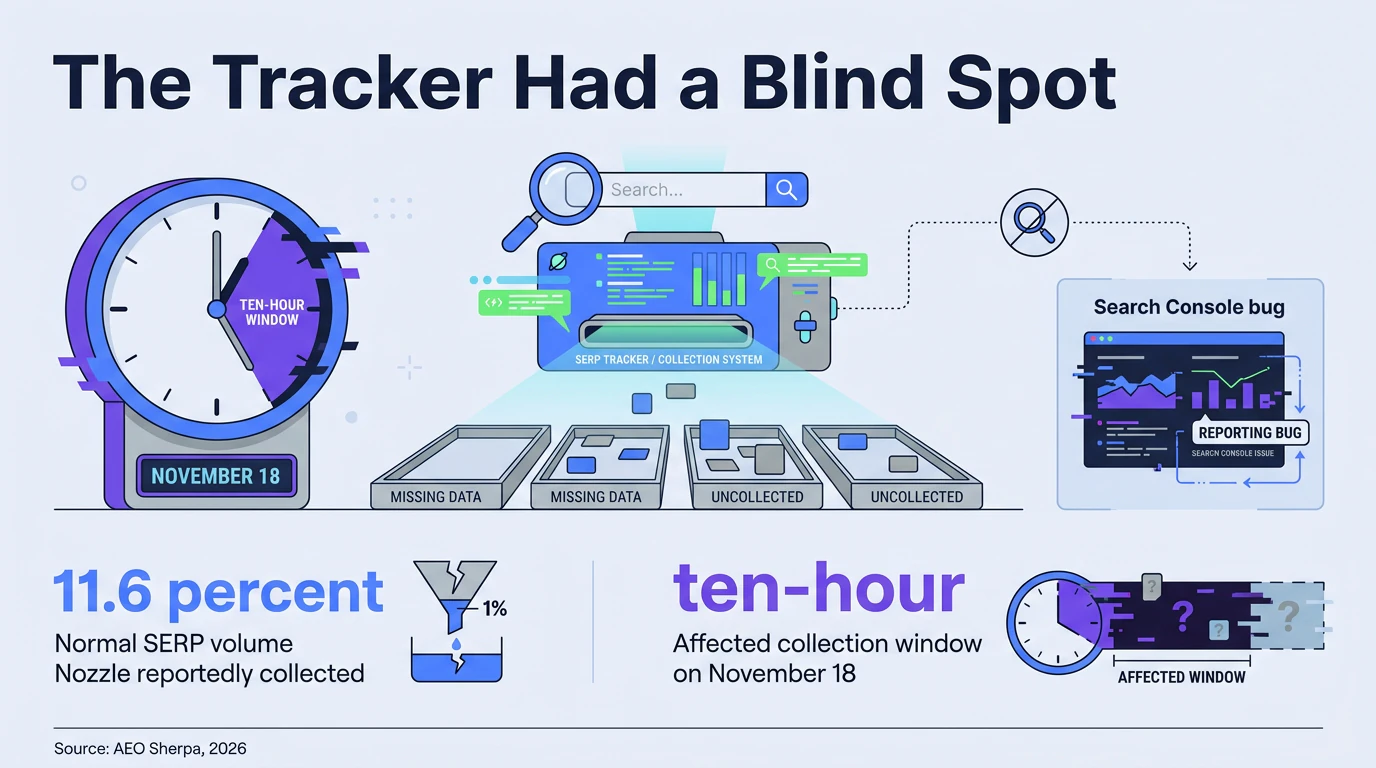
Source: AEO Sherpa, 2026
The finish date split the trackers
The November core update finished on November 24, according to Stephanie Chung’s recap covering that date. Later trackers still described an active rollout. That conflict complicates any comparison labeled “during” and “after.”
DevakaTalk’s November 20–27 tracker also said the November rollout had finished, followed by a December update announcement. Its account agrees with Chung on the sequence.
Yet AI SEO Wire’s November 25 entry labeled the rollout “Day 15 of up to 14.” On that reading, the expected window had passed without a recorded finish.
On November 26, SEO Giant’s roundup still described the update as rolling out, attributing that status to Google’s Search Status Dashboard. Publication dates alone cannot establish which account captured the latest status, especially on rolling news pages.
The calendar offers no tie-breaker. Adding ExtCafe’s expected 14-day window to November 10 lands on November 24. A calculated end date is not confirmation of completion.
Stale reporting, update timing or different dashboard snapshots could explain the split. None is established here. Before choosing comparison windows, check Google’s direct completion record and record when each secondary account was updated.
Even a confirmed finish date would settle only the boundary. A later dip would not automatically identify a content problem.
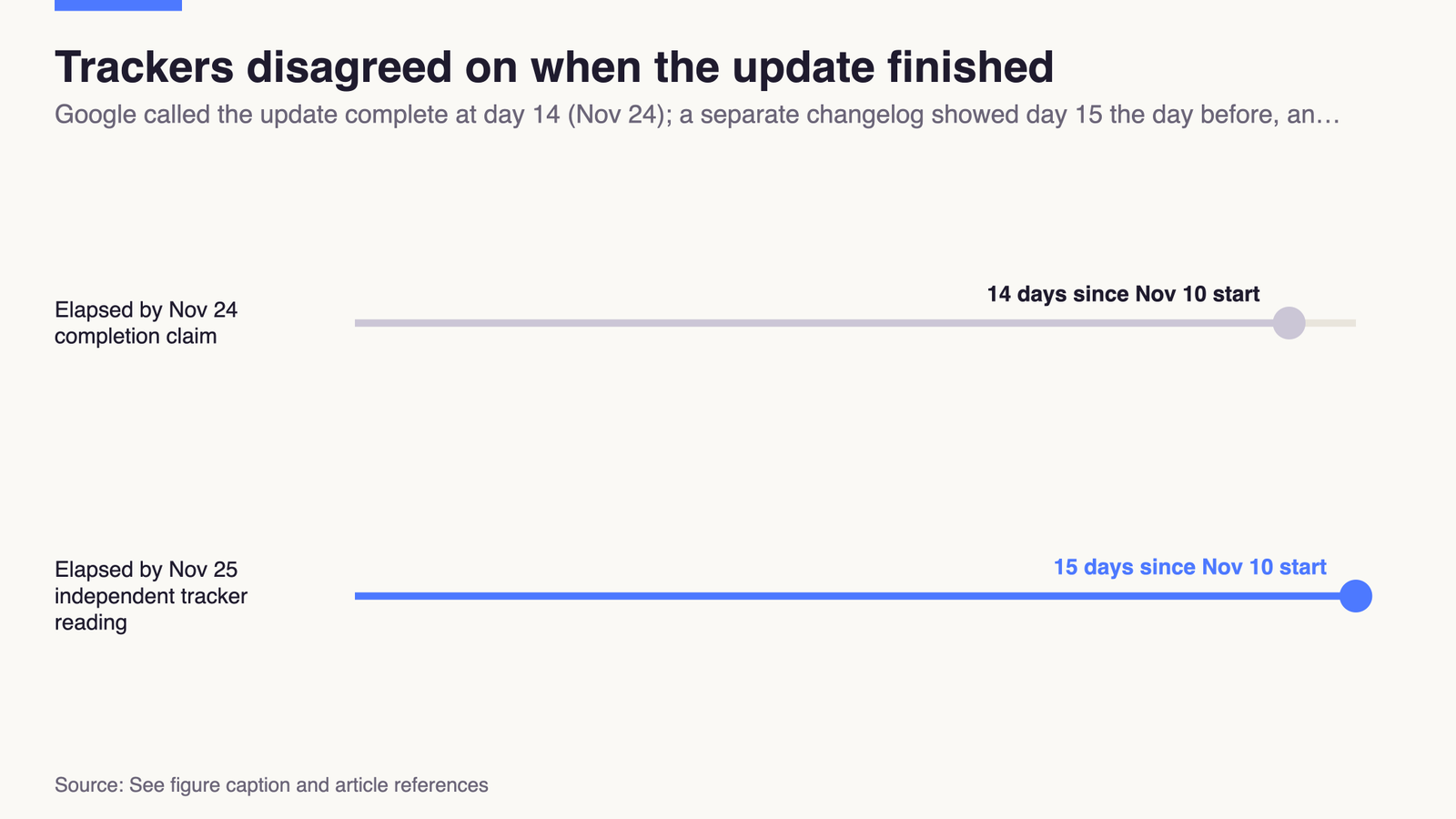
By two different readings of the same Search Status Dashboard, the core update had already matched or passed its typical window before Google called it complete. Method: Elapsed days calculated from the reported November 10 start date to each cited reading date; benchmark reflects ExtCafe's reported maximum rollout window of up to two weeks.
AI citations can move separately
The AI Mode switch raises a separate question: did the answer change its sources? Google made Gemini 4 Hydrogen the default on November 12, 2026, with no subscription required, according to McCranie’s November coverage.
A different answer model could select different sources or summarize the same pages differently. A page might lose an AI citation while holding its organic position. That is a possible mechanism, not an observed effect of this switch: the supplied evidence contains no matched before-and-after citation count tied to Gemini 4 Hydrogen.
An earlier 2026 comparison shows why clicks need a separate measure. McCranie’s September review reported a preregistered field experiment involving 1,100 Chrome users that found an 18.8-percentage-point reduction in outbound clicks with AI Mode.
That result concerns visits away from the search experience, not how often websites appeared as sources. It does not measure the November switch. A cited page and a clicked page are different outcomes.
Keep three reporting lines separate:
- Organic position: Did the page move in ordinary search results?
- AI citations: Did monitored answers stop naming or linking to it?
- Outbound clicks: Did fewer users reach the website?
Before interpreting citation trends, check the monitor itself. Parano’s account says Otterly moved monitoring from Microsoft Copilot to Bing AI Mode in the November window. A dashboard comparison spanning that change may be comparing different products, not a consistent measure of source selection.
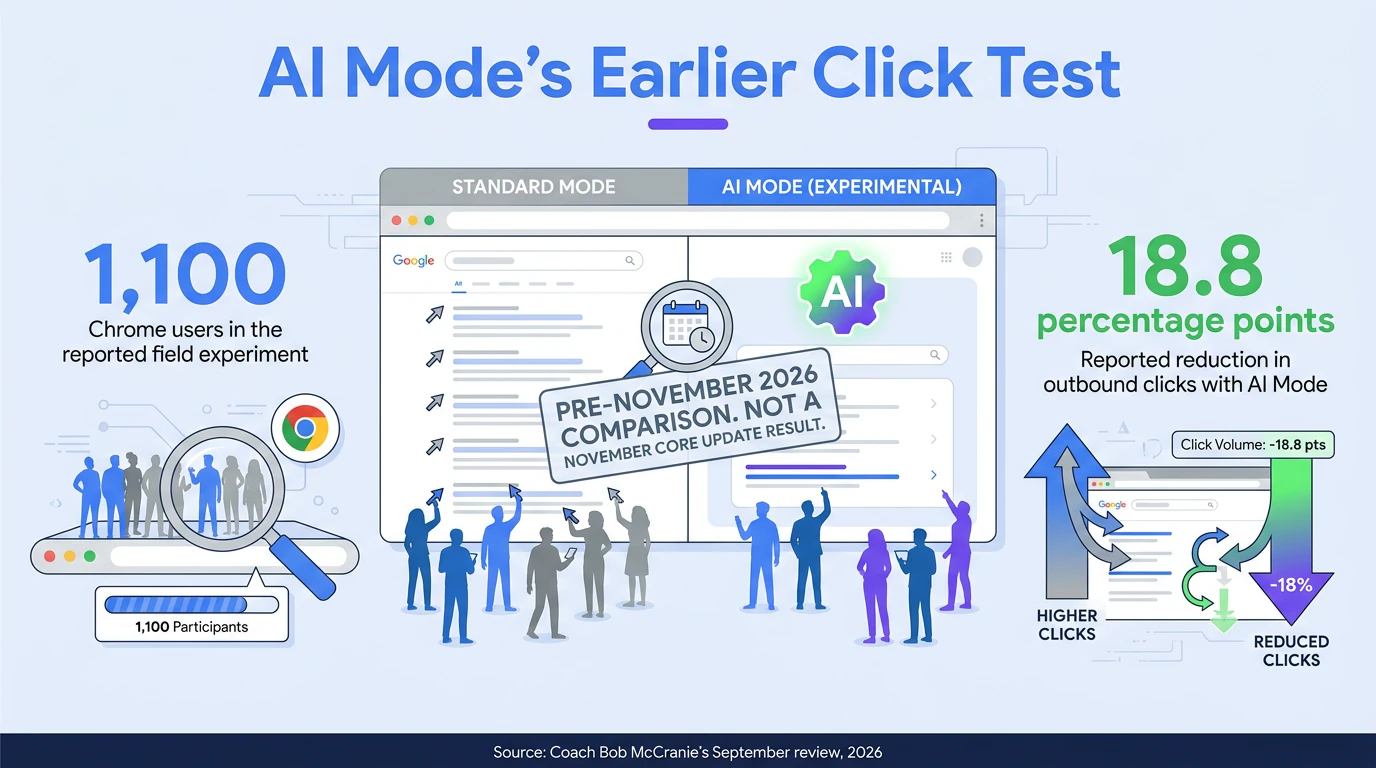
Source: Coach Bob McCranie’s September review, 2026
Run four checks before rewriting
The following four checks can narrow the explanations for a loss. They are editorial guidance, not a validated diagnostic test, and cannot isolate causation on their own.
- Preserve the export, then exclude affected impressions. Save an untouched Search Console export. Remove November 9–11 generative-AI impressions from the working comparison, following Sanbi’s advice, and label the exclusion. Use comparable, unaffected periods rather than treating a shortened month as complete.
- Check organic positions independently. October 25–November 26 is a proposed inspection window, not a source-established test period. Use ExtCafe’s chronology as context, while keeping keywords, locations and devices consistent. Flag missing observations, including any known collection outage, before interpreting movement.
- Compare citations using the same pages and prompts. Examine results before and after November 12 across Google AI Mode and other monitored engines. Keep the sample fixed and check platform continuity, particularly Otterly’s monitoring switch reported by Parano. A Google-only change would warrant closer investigation of AI Mode, but would not prove the model switch caused it.
- Inspect logs and referrals. Review server responses, crawler access and referral patterns alongside analytics collection changes. Look for blocked requests, errors or missing measurement before deciding that content needs repair.
Unchanged crawler activity does not rule out a ranking loss. A page can remain accessible and crawled while losing positions.
If the checks reveal an access problem, address it on its own evidence. If they support a content change, record the edit and its rationale so it does not become another unexplained variable.
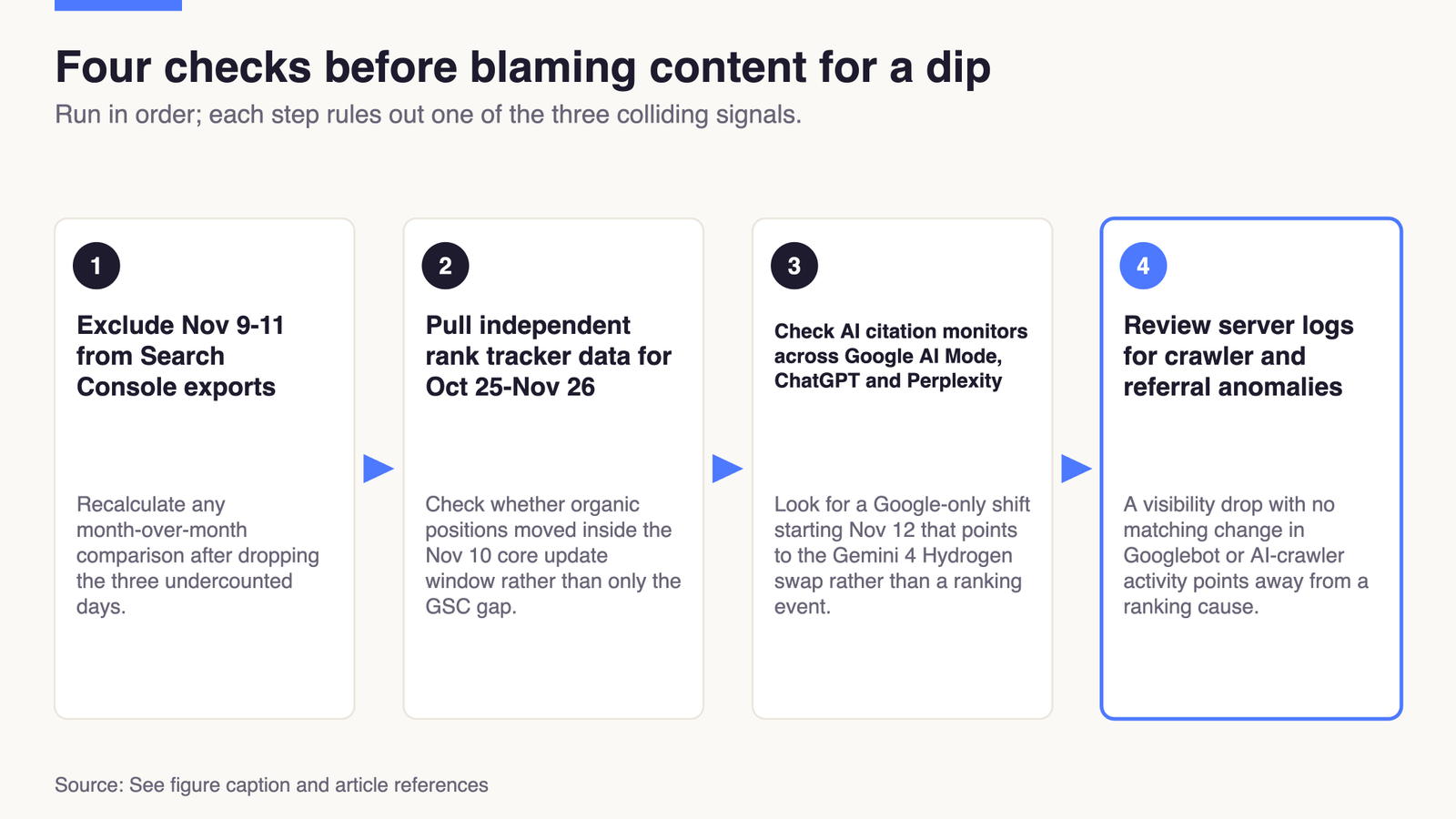
A short, ordered audit isolates which of the three November signals actually moved a page's numbers before anyone edits it. Method: Sequence built from Sanbi's documented Search Console fix and the logical order needed to rule out the core update and Gemini swap before assuming a content problem.
Some click losses started earlier
Some November declines may have started months earlier. In France, click-through rates for queries showing AI Overviews fell 24.4% during the three months after the feature’s July 22, 2026 launch, according to GEO Agencies’ reported analysis of 31,612 keywords.
That earlier comparison does not measure November’s core update or Gemini switch. It suggests a question for a longer chart: did the loss begin before either event? Without a matched comparison, it cannot establish what caused a particular site’s decline.
The units also matter. The French figure describes a relative percentage decline in click-through rate. By contrast, the AI Mode experiment in McCranie’s September review reported an 18.8-percentage-point reduction in outbound clicks among 1,100 Chrome users.
For illustration, a 24.4% relative decline would take a hypothetical 10% click-through rate to 7.56%. That is a fall of 2.44 percentage points. Neither rate is an observed endpoint from the French analysis.
These findings concern different search experiences, samples and measures. They cannot be pooled into one estimate of lost traffic, and the original studies were not available for inspection here.
Extend the November chart into earlier months where comparable data exists. Separate queries showing AI Overviews from other queries where possible, then check whether losses began before November 10 or accelerated afterward. Treat that date as something to test, not the assumed start of every decline.
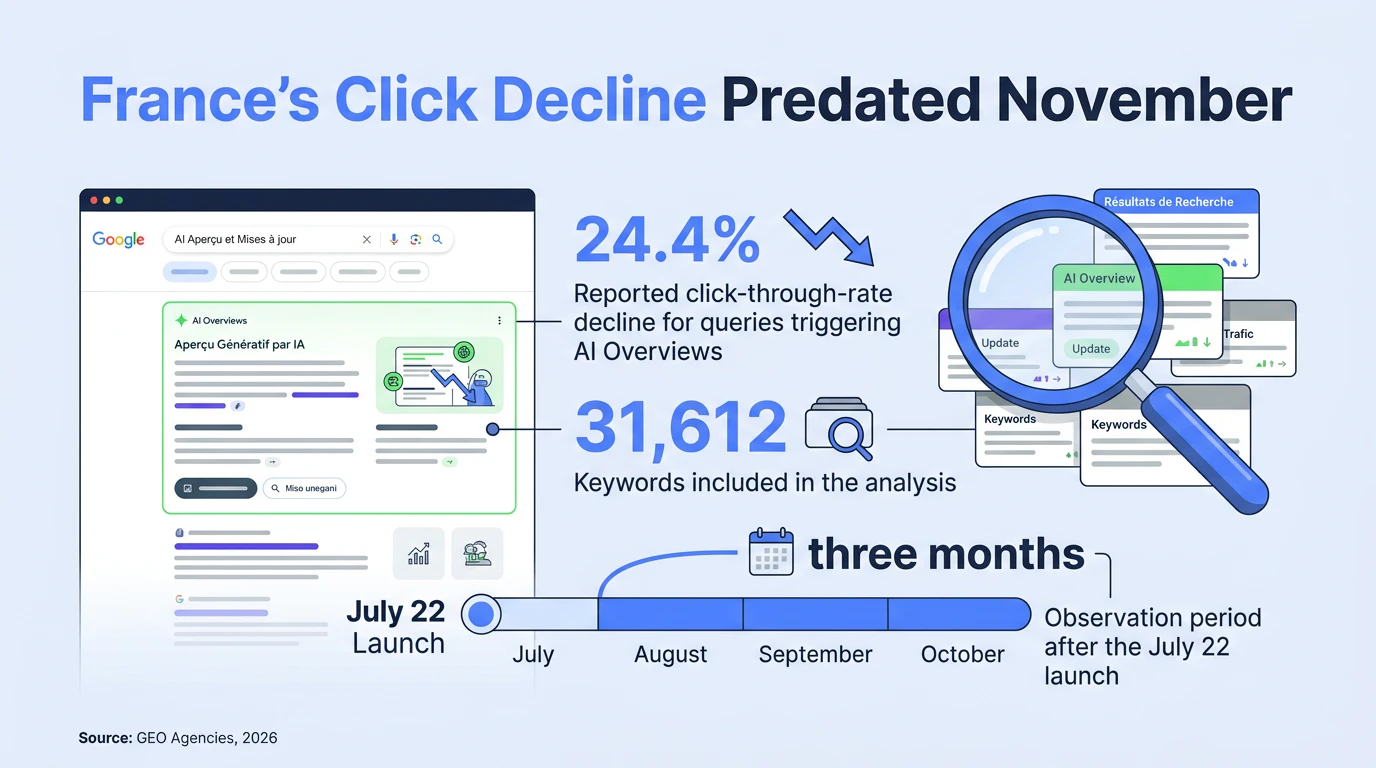
Source: GEO Agencies, 2026
Match the symptom to the next check
A three-day impression dip calls for a different check from a sustained fall in search positions. Sanbi’s account of the November 9–11 reporting gap makes that distinction especially important.
The patterns below are diagnostic possibilities, not established signatures of each event.
| Observed pattern | Possible explanation | Next check | What remains unproven |
|---|---|---|---|
| Generative impressions dip only on November 9–11 | Search Console undercounting | Exclude those dates from the affected series. Check independent traffic and position records. | Missing impressions do not establish fewer visits or weaker rankings. |
| Independently tracked organic positions change beyond the reporting gap | Ranking movement potentially associated with the core update | Compare consistent keyword records across October 25–November 26. Verify collection completeness and the rollout boundary. | Timing alone cannot attribute movement to the update. |
| Google citations shift after November 12 while ChatGPT and Perplexity remain steadier | A Google-specific AI change | Compare the same prompts and pages. Check monitoring coverage and settings. | A Google-only shift does not prove the model switch caused it. |
| Impressions, positions and citations all move, with monitoring gaps | Several changes, incomplete measurement, or both | Investigate each signal separately, then compare timing. | One shared cause remains unproven. |
Read the companion figures alongside this table: the overlap timeline establishes sequence, while the diagnostic visual organizes the next checks. Neither can supply the missing domain-level evidence needed to identify a cause.
For client reporting, distinguish recorded changes from missing data and unresolved explanations. Name the next check rather than presenting a suspected cause as a finding.
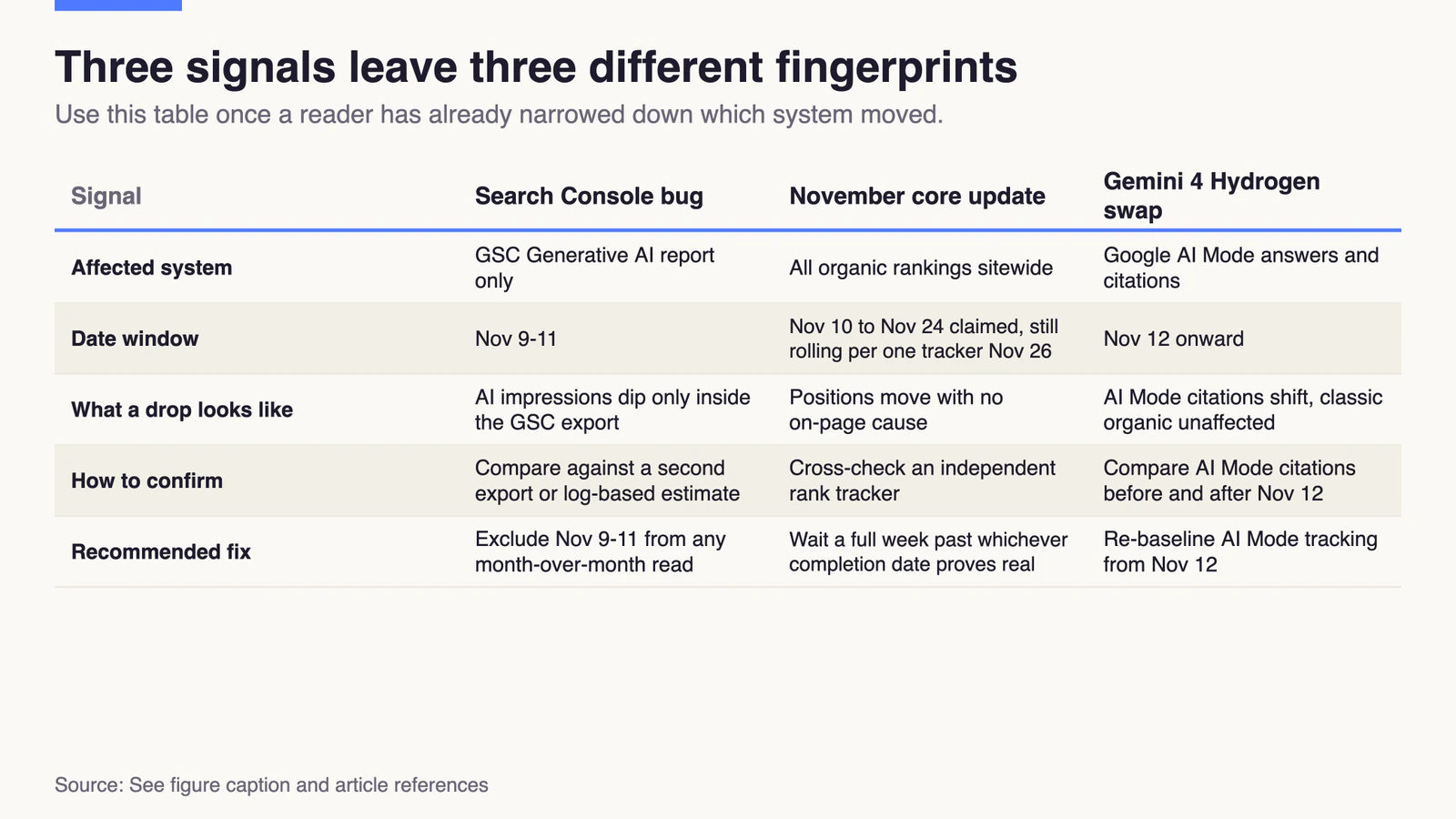
Each of the three November events produces a distinct pattern across date window, symptom and fix, which is how a reader can tell them apart without raw traffic data. Method: Built from Sanbi's documented 10-change roundup and corroborating dated reporting on the core update and Gemini swap.
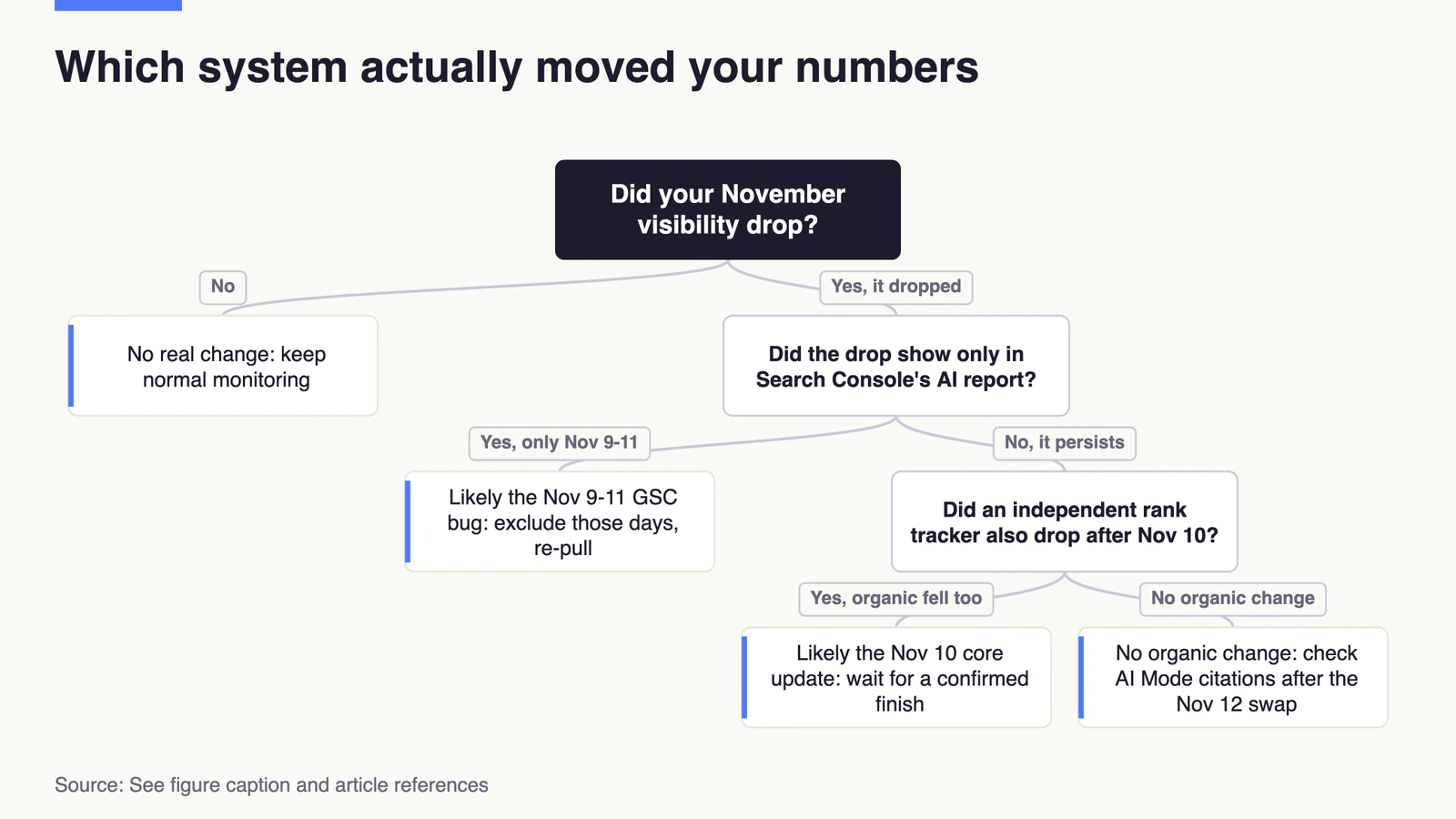
A practical five-question path from 'my visibility dropped' to a likely cause, built from the dated events this report audits. Method: Decision logic derived from the four-step diagnostic sequence, sequencing checks from cheapest and most specific (the GSC date window) to broader ones (organic rank data, then AI citations).
December is the next test
Google preannounced a December 2026 core update about an hour after marking November’s update complete, according to Chung’s recap covering November 24. A preannouncement is not a rollout. The supplied account does not establish a December launch date.
Before the next comparison, preserve a baseline that can be inspected later:
- Save original exports and mark reporting gaps rather than treating them as zero activity.
- Record changes to monitored platforms, query sets and collection settings.
- Check Google’s official status record before assigning movement to an update.
- Date page edits and record the evidence behind them.
Business outcomes deserve their own check. Vibe Marketing’s account of Seer’s data attributes to Wil Reynolds a finding that direct traffic converted at roughly 2.5 times the rate of AI-sourced traffic at his firm. The supplied snippet is truncated, so that multiplier is approximate and not a benchmark for other sites.
Compare conversions alongside visibility, but keep their explanations separate. The next useful signals are confirmed rollout dates, complete reporting coverage, and ranking or citation patterns that recur under consistent measurement. Those are firmer grounds for action than a single dip or an arbitrary waiting period.
Limitations
- The supplied evidence consists largely of secondary reporting and summaries. Google’s dashboard, original studies and underlying datasets were not independently inspected.
- No matched domain-level traffic, ranking or citation results establish that a particular loss came from the core update or model switch.
- The magnitude of the Search Console undercount is unknown. Three affected days do not imply a particular percentage of lost impressions.
- Tracker reports conflict on completion dates. Some rolling news pages have publication dates preceding the events they describe, limiting chronological checks.
- Earlier 2026 studies use different samples and measures. They provide context, not estimates of November’s impact.
- The conversion comparison attributed to Seer rests on a truncated source snippet and should be treated as approximate.
References
- SEO, AEO and GEO News: Daily Search Updates - SEO Giant
- AEO News: AI Search, AEO & GEO Updates
- News
- What Changed in Search: SEO, GEO and AEO Tracker
- Search & GEO
- SEO, AI, AEO & GEO: A Week in Review – Coach Bob McCranie ...
- GEO Platforms industry news: weekly company updates
- Google SEO, AEO and GEO Updates 2026 (Updated 21 Nov) | ExtCafe
- AEO & GEO News, November 2026: 10 Changes That Matter
- SEO News - Google, AI Search & GEO Updates
- SEO & AI Search News: Google Core Update, ChatGPT Business
- November 2026 AI Search Updates: 5 Major Changes Shaping SEO, GEO & AI Visibility
- Google's December core update preannounced and a new ranking hub | SEO Recap covering November 24, 2026
- AI SEO Wire: Google updates, AI search and GEO news